Evolution

21 February 2022: ‘US’ Part 2 – Burdalone

‘Burdalone’ is an old Scottish word meaning the last bird in the nest, the one left when all the other chicks have flown or all the other chicks have died. It’s a sad and lonely word, and perfectly describes Homo sapiens.

When one of the first members of our own species studied the world around her, most of what she saw would be familiar to us today, whether from personal experience or from watching nature documentaries about Africa. Extensive grasslands dotted with acacias, watering holes and narrow rivers with crumbling banks, herds of large grazing animals such as wildebeest and zebra, black herons and lizards, secretarybirds and crocodiles, a lion pride or two, and our deadliest predators – a leopard and a pack of hyenas.

The south African Highveld, the kind of savannah our ancestors evolved in over four million years ago. Photo: Simon Brown.

What she also saw, and which none of us will ever see, is other groups of human beings that were not H. sapiens. Like our ancestor, they were striding on two legs and using their large brains and opposable thumbs to harvest nuts and berries, sometimes to hunt or scavenge for meat, and to fend off predators. They looked very similar to us, used tools, and some may even have created art and used language to talk to one another.

Around 350,000 years ago, at this stage the earliest date we know H. sapiens might have first strode the planet[i], there was no reason to think things would ever change.

But to say that we are human today is to say that we are members of a single worldwide species. This is extraordinary because for millions of years to be human meant that you could be a member of any one of a number of different but related species.

It should not be contentious to say that all members of the genus Homo are human – after all, this is what the Latin word ‘homo’ means – but it is contentious to suggest, as I will later in these posts, that all bipedal great apes are human.

But first it’s important to state that it’s currently impossible, and may forever be impossible, to finally determine when we stopped simply being hominids – that is, all the apes except for the gibbon – and became hominins as well – that branch of the hominids exclusive to us and our human cousins; this is the point at which chimpanzees went their way and we went ours.[ii] We may never know exactly when the thousands of physical and psychological characteristics that distinguish us from other great apes evolved; what we can be sure about is that almost of them were shared with at least some of our hominin ancestors.

We are so close to our cousins, genetically and historically, that making a distinction between whether or not they are human seems farcical. Indeed, the same argument can be made for any two species close to each other in the hominin line.

In 2005, British celebrity Alan Titchmarsh allowed professional make-up artists to disguise him as a Neanderthal; he then walked along the streets of London, almost completely ignored by everyone.[iii]

Homo sapiens or H. neanderthalensis?
Courtesy of Creative Commons. Photographer unknown.

At some point we need to demarcate between those species we consider human and those we consider pre-human, and to date the only specific marker that distinguishes all of us from all of them is bipedalism, not some arbitrarily determined measurement of brain capacity, morphology or dentition.

As well, research into the workings of the human brain, and into animal intelligence generally, has thrown into doubt those psychological characteristics we traditionally considered to be peculiarly human, characteristics that made us special and put us above the rest of the animal kingdom. Once upon a time, we were considered the only animal to make tools, then the only animal to make tools and smile, then the only animal to make tools, smile and do handstands.

It’s similar to a town building a bridge and claiming it’s the only bridge in the world, only to discover that a nearby town has one as well. So the first town now claims it’s the only single-span bridge in the world, until it learns there is a another single-span bridge in the next county. The first town now claims it is the only single-span bridge in the world with green arches, and so on, every new definition increasingly trivialising what makes its bridge special.

There is strong evidence that intelligence has arisen many times in the animal kingdom: in primates, cetaceans, elephants, larger carnivores such as dogs, hyenas and the big cats; birds, particularly corvids and parrots; and some molluscs such as octopuses and possibly squids.

There is also growing evidence that self-awareness and even a theory-of-mind[iv] exists in other primates such as chimpanzees and some birds such as crows.

There is growing evidence that animals other than humans, such as chimpanzees, have a Theory of Mind. Courtesy of Creative Commons. Photographer unknown.

So what are the characteristics that separate humans from our nearest living relatives, the chimpanzee and bonobo?

Before we answer that, we have to talk taxonomy and cladistics – how scientists classify living things.

Life is a spectrum

In his book The Vital Question, biochemist Nick Lane writes that ‘the distinction between a “living planet” – one that is geologically active – and a living cell is only a matter of definition … Here is a living planet giving rise to life, and the two can’t be separated without splitting a continuum.’[v]

Different scientists may employ different markers or waypoints in determining the start of life on Earth, all of which are subject to controversy and disagreement, but the truth is that there is no precise point in time when anyone could claim that a given chemical process for the first time was created by life rather than geology; it would be an arbitrary decision.

The same principle applies throughout evolution. There is no precise point in time where we can say fish gave rise to amphibians or basal reptiles to dinosaurs.

Changes in life brought about by evolution through natural selection isn’t episodic, it’s a spectrum.

But evolution does present a handful of events when with some certainty we can say a new direction had begun – a direction with significant ramifications for all life that follows.

The first of these, and covered in some detail in The Vital Question, concerns the creation of the eukaryotic cell: a morphologically complex cell that contains a separate nucleus and mitochondria, each surrounded by a double membrane. As far as we know this remarkable event occurred only once in all history[vi]. An archaeon, a single-celled prokaryote, absorbed another kind of prokaryote – a bacteria – and instead of consuming it established a symbiotic relationship.

The eukaryotic cell – morphological complexity derived from the synthesis of two prokaryotes, an archaeon and a bacterium. After the creation of life itself, this synthesis is perhaps the most significant event in the history of our planet. Courtesy of Creative Commons.

At some point later in history, some of the descendants of that first complex cell started a symbiotic relationship with a second prokaryote invader, creating chloroplasts and starting the line that would eventually lead to plants and green algae.

More recently, the arrival of the first human was an event with tremendous ramifications for all life on earth.

But when did this happen?

The king of Spain did what?

Before we go any further, we need to talk about a subject that normally works like a sedative on anyone not interested in taxonomic detail: the organisation of the taxa themselves.

I promise to keep this short and to the point, but it’s important to cover because we need to reconsider how and where our human family fits in with other living thing. And, of course, when it all happened.

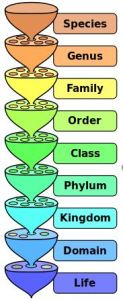
Mnemonics are as much a part of school science classes as microscopes and Bunsen burners. For example, one mnemonic frequently used in the last century for memorising the different taxonomic ranks was ‘King Philip Came Over From Great Spain’, a mnemonic for the main taxa in the Linnaean system:

Courtesy of Creative Commons.
  • Kingdom,
  • Phylum,
  • Class,
  • Order,
  • Family,
  • Genus, and
  • Species.

Taxonomic ranking has been around for as long as humans have been curious about the natural world, but the above ranking developed from a system introduced by the Swedish naturalist Carl Linnaeus in the 18th century. He wanted to organise living things so their biological relationship to each other was made very clear. He did this by using shared characteristics to lump things together.

For example, these days all animals with fur, warm blood and that suckle their young with milk are put into one group, the class called mammals. The mammals themselves are grouped together with all animals with a backbone to form a phylum called the chordates. The chordates and animals without a backbone are thrown together into a kingdom called Animalia. More formally, taxa – the collective noun for the rankings – sharing a more recent common ancestor are more closely related than they are to taxa which share a more remote common ancestor: in other words a wombat is more closely related to a dog than it is to a crocodile, and more closely related to a crocodile than it is to a flatworm.

Linnaean taxonomy also introduced the binomial, the familiar two-name identifier used in science to classify an organism at the most detailed commonly used level, that of species. Homo sapiens, for example, is the binomial for human beings, just as Panthera leo is the binomial for lions and Quercus robur is the binomial for the English oak. The first word is the genus (plural genera), the second the species.

Taxonomy is a lovely idea, and appeals to anyone who thinks good old common sense is all you need when sorting bookshelves and tidying kitchen cupboards. For over two hundred years it was regarded as an almost fool-proof system: a place for every living thing and every living thing in its place.

But our knowledge of the natural world is not like that of our kitchen. Like the natural world itself, it is messy, chaotic, growing and constantly evolving.

In 1990, American microbiologist Carl Woese (1928-2012) suggested a new step was needed at the top of the taxonomic ladder to reflect the discovery of a whole branch of life whose existence was never suspected until the 1970s. The archaea, single-celled prokaryotes, were long thought to be a kind of bacteria, but work by Woese and other scientists revealed they are as chemically different from bacteria as we are.

The commonly accepted taxonomic ranks now start with ‘domain’, leaving us with cumbersome and self-defeating mnemonics such as ‘Determined, Kind People Can Often Follow Ghostly Screams’ or ‘Do Kings Prefer Chess On Fridays, Generally Speaking’.

Domain isn’t the only extra rank added over the decades. We also have ‘subfamily’, ‘tribe’, and sometimes ‘subtribe’, ‘subgenus’ and ‘subspecies’, and that’s just in the field of zoology.

In the story of ‘Us’ we’ll be dealing mainly with genus and species, and in the next post we’ll discuss what makes up both taxa.

Other posts in this series can be found here:

‘Us’ Part 1 – Out of Africa

‘Us’ Part 3 – The devil in the detail

‘Us’ Part 4 – Using your noggin

‘Us’ Part 5 – Feet and socks

‘Us’ Part 6 – Kith and kin


[i] https://simonbrown.co/2017/10/07/07-october-2017-new-evidence-suggest-we-are-much-older-than-300000-years/

[ii] Some palaeoanthropologists include chimps and bonobos in the hominin. Rather than outlining all the arguments for or against, I’ll err on the side of caution and include only our immediate family in the hominins.

[iii] Titchmarsh did this in the wonderful natural history series The British Isles: a Natural History. See https://www.bbc.co.uk/programmes/b01fkhdx.

[iv] This is the ability to attribute mental states similar to your own to other members of at least your own species and possibly other species as well.

[v] Lane, Nick; The Vital Question; London, 2015; p 27.

[vi] This may have happened a second time. A single-celled organism with a nucleus, and possibly mitochondria, dubbed Parakaryon myojinensis, was retrieved a few years ago from the foot of a sea creature found off a coral atoll not far from Japan.

The main difference between P. myojinensis and all other eukaryotes is that its nucleus and mitochondria are surrounded by a single membrane instead of a double one, and its DNA is stored in filaments (as in bacteria) suggesting it is the result of a different line of evolution from all other eukaryotes. Indeed, there is some argument as to whether it is a true eukaryote at all. The only thing that can be said with some certainty is that it is definitely not a prokaryote.

No other example of this creature, or anything similar, has since been recovered. Nonetheless, when it comes to science, hope springs eternal …

See here for more information.

18 February 2022: ‘Us’ Part 1 – Out of Africa

It’s us and us, not us and them

This and the following five posts will be about Us. Not Uncle Sam or Ultra Sound or Ultimate Spas. Not you and me. But all of Us. Every single human alive today and every single human who has existed in the past. And by every human I mean every member of the genus Homo, and every member of the genera Australopithecus, Kenyanthropus and Paranthropus, a lineage that stretches back nearly five million years in the past and is still going strong today.

I considered another title for this series of posts – ‘Mongrel’ – because Homo sapiens are mongrels. I don’t mean in the way an Australian might call you a ‘mongrel’ if you rear-end his ute or support a different footie team, but in the sense that we are animals of mixed breeding.

Colin Grove. Photo: Simon Brown

I want to write about the revelation made by palaeoanthropology over the last 25 or so years that Anatomically Modern Humans (AMH) have no single direct ancestor. The different species that gave rise to us bred with each other again and again, cross-pollinating over millions of years. We are, each and every one of us a mulatto, a crossbreed, a cafuzo, a zambo … in short, a mongrel. This is something for us to crow about. We are the beneficiaries of millions of years of striving, surviving and thriving by many other members of our hominin tribe. Having said that, recognising that we owe our existence to a plethora of species and not to one single predestined or divinely sanctioned line of descent, may also help us shed our belief in the exceptionalism of H. sapiens.

These posts are also a way for me to record a project I long dreamt of doing and eventually started some six years ago but can no longer complete, a book about hominin evolution I was writing with my friend, the late Colin Groves[i]. I cannot write that book without Colin –  his knowledge and experience were unique even in the rather rarefied circle of palaeoanthropology – but what I can do is finally record as faithfully as possible some of his ideas about hominin evolution.

To start with, I’d like you to meet a small child. A child named Taung.

Darwin was right

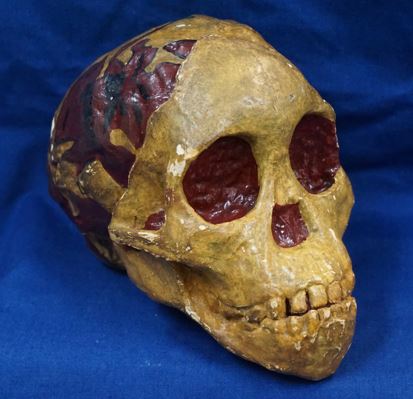
The child first came to attention in 1924 when it’s tiny skull was discovered by Raymond Dart in one of two boxes of tufa and sandstone debris he received as he was dressing to attend a wedding as best man.

Dart, an Australian doctor and anatomist, had only recently taken up the post of professor at the University of Witwatersrand in Johannesburg, and had spread the word he was interested in any fossils his students or acquaintances might uncover to help stock his fledgling laboratory. In this case, the debris was from a limestone quarry in Taung, a small mining town in South Africa’s Northwest Province.

When the boxes arrived he hurriedly inspected them. In the second box he saw something that changed his life and the history of palaeoanthropology.

In his own words, a thrill of excitement shot through him.

‘On the very top of the rock heap was what was undoubtedly an endocranial cast or mold of the interior of the skull. Had it been only the fossilised brain cast of any species of ape it would have ranked as a great discovery, for such a thing had never before been reported … a brain three times as large as that of a baboon and considerably bigger than that of an adult chimpanzee …

Cast of Taung child. Photo: Simon Brown

‘But was there anywhere among this pile of rocks, a face to fit the brain? I ransacked feverishly through the boxes. My search was rewarded, for I found a large stone with a depression into which the cast fitted perfectly … Here I was certain was one of the most significant finds ever made in the history of anthropology.

‘Darwin’s largely discredited theory that man’s early progenitors probably lived in Africa came back to me.’[ii]

Indeed, Dart’s discovery eventually switched the focus of palaeoanthropology’s search for the origin of our species from Eurasia to Africa, an origin Charles Darwin had predicted in The Descent of Man in 1871.

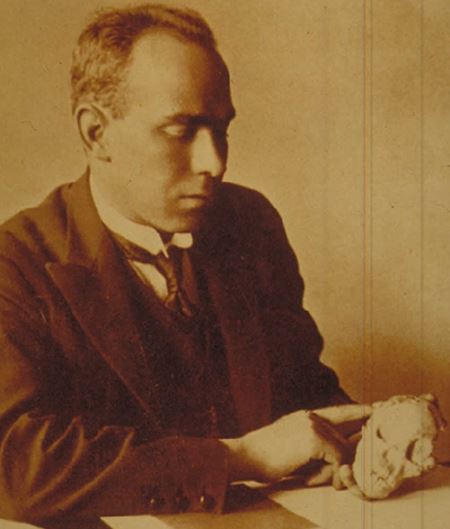
Using his wife’s knitting needles, it took Dart weeks to separate the Taung Child (Taung 1) from its breccia matrix. The paper[iii] he wrote about the discovery appeared in Nature in early 1925, and in that paper he named the specimen Australopithecus africanus, Africa’s southern ape.

Raymond Dart with the skull of the Taung child. Courtesy of Creative Commons. Photographer unknown.

At first, the scientific establishment reacted negatively to Dart’s hypothesis that the Taung Child represented an ancestor of modern humans. Heretofore it had been believed humans must have evolved in Europe or Asia, a belief reinforced with the discovery of H. neanderthalensis in 1829 (but not recognised as a different species from us until 1856) and H. erectus in Java in 1891 (a story we’ll come back to later in this series of posts).

Over the following decades, however, the number and diversity of fossils uncovered in southern and eastern Africa have overwhelmingly supported the ‘Out of Africa’ hypothesis for human origins.[iv]

The Taung Child itself was thought to be about three years old when it died. Not only was its life short, it ended violently. In 2006, the University of Witwatersrand’s Lee Berger wrote that marks in the Taung Child’s eye sockets and on its skull suggested it was probably killed by a large bird of prey.[v]

Even though it was the first described member of the genus, it turned out A. africanus was not its oldest member, and may not even have been one of our direct ancestors.

Meet the great-great-great-grandparents

At the risk of making a bad rhyme, exactly what does it mean to be an Australopithecine?

This is a matter of debate. Some scientists merge a chronologically older primate genus, Ardipithecus, with Australopithecus, to make the subtribe Australopithecina. Others leave out Ardipithecus, and include Paranthropus and Kenyanthropus with the Australopithecines. While they’re at it, some scientists consider Australopithecines to be a member of the human family, while others think the family starts much later – with the first species in the genus Homo.

It gets very confusing very fast, especially since every new discovery – and over the last 25 years there have been many of those – seems to generate a new species and subsequently a new debate of what it means to be human, hominin, or hominini (generally accepted to be humans plus chimpanzees). Or for that matter, what should be included in the genera Australopithecus, Homo, Paranthropus and so on and so forth.

For the sake of these posts, I’m assuming at this point that Australopithecines are fine and upstanding members of our human family. Great-great-great-grandparents (or cousins to the nth degree), in a manner of speaking. At a later point  I’ll be examining more deeply what makes a genus … but we’ll paddle that delta when we get to it.

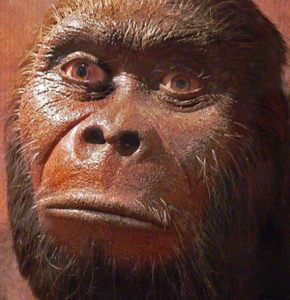
Australopithecus anamensis: the first human? Courtesy of Creative Commons. Photographer unknown.

The oldest species belonging to this genus is A. anamensis[vi], kicking off just over four million years ago (mya). Other Australopithecines include A. garhi, A. afarensis (Lucy is probably the most famous example of this species, if not the most famous human fossil of all), A. bahrelghazali, A. deyiremeda, A. prometheus and A. sediba. A. sediba is the last known of the genus as well as the most recently discovered[vii], existing as recently as 1.8 mya, making it a contemporary of one of our ancestors, H. ergaster.

Over the two million plus years the genus existed, cranial capacity jumped from around the 360cc mark (slightly smaller than the average for a chimpanzee) to nearly 440cc, an increase of over 20%.

The Australopithecines are generally thought to have given rise to our genus around 2.4 mya. Occasionally one Australopithecine or another is nominated as materfamilias, but the truth is no one really knows which species – if any of those so far discovered – gave rise to our side of the family. As well, there is constant toing and froing about how many species there actually are (and as we’ll see the same toing and froing goes on in discussions about the members of our own genus).

In the next post I’ll discuss what lays at the heart of all of these debates: the big question, a question that may never be satisfactorily answered.

What makes a human … well, human?

Other posts in this series can be found here:

‘Us’ Part 2 – Burdalone

‘Us’ Part 3 – The devil in the detail

‘Us’ Part 4 – Using your noggin

‘Us’ Part 5 – Feet and socks

‘Us’ Part 6 – Kith and kin


[i] For a full obituary, refer to the ANU’s Life Celebrations.

[ii] Dart, Raymond A. with Dennis Craig, Adventures with the Missing Link, London 1959.

[iii] https://www.nature.com/articles/115195a0

[iv] Including the discovery of Mrs Ples (STS 5) in 1947 by Robert Broom and John T. Robinson, an almost complete skull of A. africanus. (For more on Mrs Ples, see my earlier blog here.)

[v] https://www.semanticscholar.org/paper/Brief-communication%3A-predatory-bird-damage-to-the-Berger/15a0f813e5c4c978810bfee965fea1dcfdcb67f0

[vi] https://www.abc.net.au/news/science/2019-08-29/ancient-fossil-skull-found-in-ethiopia-fills-human-evolution-gap/11444130

[vii] In 2008, by Matthew Berger, the 9 year old son of University of Witwatersrand palaeoanthropologist Lee Rogers Berger.

29 March 2021: Hyenas, human exceptionalism and hubris

The late Australian philosopher and ecofeminist Val Plumwood was attacked and almost killed by a saltwater crocodile in 1985. The fact she survived three ‘deathrolls’ is down to her sheer determination to escape and a good amount of luck. Severely injured, one leg was exposed to the bone, she somehow managed to walk and finally crawl to the nearest ranger station, some three kilometres away.

In her essay ‘Prey to a crocodile’, Plumwood writes that during the attack ‘I glimpsed the world for the first time “from the outside”, as a world no longer my own, an unrecognizable bleak landscape composed of raw necessity, indifferent to my life or death.

‘ … It was a shocking reduction, from a complex human being to a mere piece of meat.’

Saltwater crocodile. Courtesy of Creative Commons, photographer unkown.

Human exceptionalism is the belief that we as individuals and as a species are separate and superior to all other life on earth. It is a belief innate in almost each and every human, especially those belonging to so-called developed societies, that stems from our almost complete domination of the planet’s landscapes and ecologies. We are the world’s most numerous large animal, and our technology has enabled us to travel from the deepest abyss to the surface of the moon. Some aspects of our technology are overwhelmingly prolific and invasive: plastic, for example, is now found from the highest point to the lowest point on Earth’s surface and throughout our own food chain.

Human exceptionalism partly stems from the way we historically treat the animals and plants with which we share the planet. They are the resources we need to survive and thrive, and we reshape entire ecosystems to sustain industries that provide those resources in the cheapest, most efficient and in the greatest amount possible. This has been at the expense of vast swathes of rainforest, wetlands and temperate forests, environments essential to the health of life on earth.

But as Val Plumwood discovered, it doesn’t take much to reduce a single human being from a member of the planet’s dominant animal to just another source of food.

#

In 2020, in the middle of South Africa’s first and strongest COVID-19 lockdown, I wrote a short story called ‘Speaker’ for a competition run by Sapiens Plurum, an organisation created to ‘inspire (humans) to aspire beyond what was humanly possible.‘

The competition’s theme was ‘how can technology increase empathy and connection?’ They wanted authors to imagine ways technology can improve how we relate to each other and bring us closer, even across species.

The idea for ‘Speaker’ came from one of those moments of serendipity – or perhaps synchronicity is a better term – when two ideas fuse to create a third idea. The first idea was based on the development of protein microchips, a scientific endeavour that had its research heyday in the 80s; one objective of the research was finding a way to help people suffering from brain injury to regain full health. The second idea is a personal fantasy, really to one day communicate with one of our hominin cousins, such as Homo neanderthalensis or H. ergaster. The fusion of these two ideas created the third idea: using linked protein microchips for communication between two modern species, Home sapiens and, in this case, Crocuta crocuta – the spotted hyena[i].

The story won the competition, and subsequently Sapiens Plurum asked Slate Magazine to consider publishing it. Slate agreed, and in January published it in Future Tense, a partnership between Slate, New America (a Washington-based think tank), and Arizona State University’s Center for Science and Imagination.[ii] Specifically, my story was part of series sponsored by the Learning Futures initiative out of Mary Lou Fulton Teachers College at ASU.

Stories appearing in Future Tense have a ‘response essay’ written by someone who is an expert in the field or issue covered by the story. In my case, I was fortunate to have Iveta Silova, an expert in global futures and learning, write the response in a piece called ‘If Nonhumans Can Speak, Will Humans Learn to Listen?’

As an extra bonus, Mary Lou Fulton Teachers College then arranged for an online discussion between Iveta, Punya Mishra, a professor and Associate Dean of Scholarship and Innovation at the college, and myself, on the creation of ‘Speaker’ and the issues covered by it and Iveta’s response. That discussion was recorded and subsequently uploaded to YouTube.

The discussion’s central issue turned out to be about human exceptionalism. As Iveta explains in her essay:

‘Today … we are forced to acknowledge that we are not so special after all. On the one hand, we wonder and worry whether artificial intelligence will become conscious, leading us down a dystopian spiral of human irrelevance. On the other hand, we see a major shift in scientific thinking about plant intelligence and animal consciousness, suggesting that the difference between human and nonhuman species is just a matter of degree, not of kind. Meanwhile, our hyperseparation from the natural world is threatening every species on Earth—including humans.’

Iveta goes on to write that ‘Overcoming the modernist assumption of human exceptionalism and reconfiguring our relationship with a more-than-human world is a complex and long-term project.’

In ‘Speaker’, linking humans with different species is an attempt to overcome human exceptionalism, but the exercise itself is fraught with difficulties, especially the hurdles imposed by our own innate prejudices and assumptions about what it means to be human in a world that seems to be so completely dominated by humans.

Spotted hyena. Courtesy of Creative Commons, photographer unknown.

And this is where our hubris kicks in. For the most part life on Earth is dominated by viruses, archaea and bacteria, but we are so coddled by civilisation that even if we understand this intellectually, it is usually impossible to acknowledge it instinctively. The current Covid-19 pandemic, for example, has demonstrated that for all our technological and cultural achievements, our entire civilisation can be put on hold by a virus so small that all the world’s Covid-19 particles can be contained a single soft drink can. It is well to remember that in ancient Greek tragedies, hubris comes before a great fall.

Linked to that hubris is the assumption in the story that given the capacity to link our own minds with those of other animals, we will go ahead and do it. The story doesn’t engage with the ethical issues of communicating in such a way with another species. For example, what repercussions would there be for the recipient species? How do we stop the link resulting in one species overly influencing or even dominating the other? In fact, how would we even begin to estimate what impact there might be? And if the decision was made to go ahead and make the link, how do we deal with the issue of privacy? How do the two linked intelligences stop invading each other’s most private thoughts? Can thoughts be turned on and off like a tap, or would the link open a floodgate that would drown both parties in a wave of facts, emotions and random thoughts?

Perhaps most importantly of all, and in the context of ‘Speaker’ the most relevant, is how do we interpret those thoughts? How do we know for sure that our brains won’t ‘mistranslate’ the thoughts it receives, and vice versa? In the story this is handled with the ‘joking’ subtext, the way Akata and Samora try to find a way around their very different life experiences to reach a common understanding for the concept of humour, something humans but not hyenas possess (at least in the story).

And yet, despite all of these issues, I see linking with another species as a wonderful opportunity and a positive action at so many levels. In her responding essay, Iveta actually quotes Val Plumwood:

‘According to … Val Plumwood, we must reimagine “the world in richer terms that will allow us to find ourselves in dialogue with and limited by other species’ needs, other kinds of minds.” This is, she argues, “a basic survival project in our present context.”’

It’s time for humans to put aside their exceptionalism and hubris. Apart from the damage to the planet such an attitude encourages, it damages us, keeping us artificially apart from the rest of life on earth. We cannot flourish as a species by ignoring the fact that we, like spotted hyenas and saltwater crocodiles and for that matter centipedes and flies, are animals. We aren’t the endpoint of evolution, just one of its offshoots.

[i] An animal seriously misrepresented in human culture. The spotted hyena is an intelligent and extraordinarily social predator that lives in large troops dominated by females. And I do mean ‘predator’; despite its historic image as a scavenger, almost all its food comes from actively hunted prey and not from stealing some other animal’s kills.

[ii] The story can be found here.

14 January 2021: An introduction to Mrs Ples

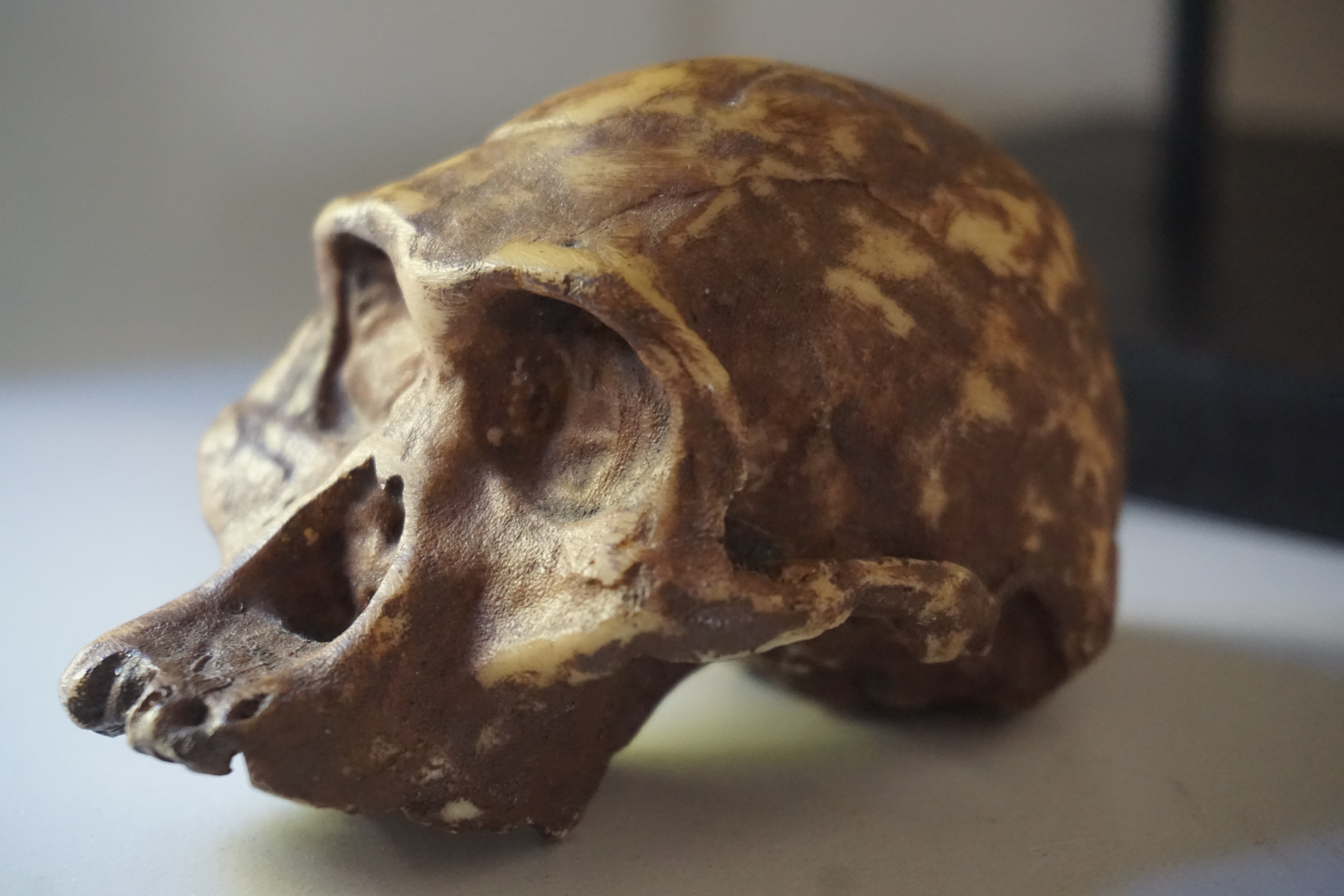
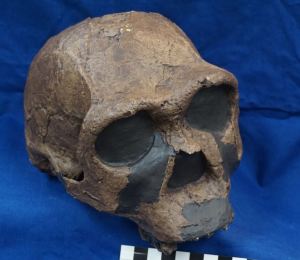
Mrs Ples is the oldest thing in my house. Although, to be honest she’s just a representation of the original Mrs Ples. And, to be even more honest, my Mrs Ples is only one-third the size of the original.

Mrs Ples has more than one name, and her history is, to say the least, turbulent.

But first, the big reveal. Mrs Ples is the oldest complete skull we have of Australopithecus africanus, a member of the great apes that includes us – the hominims. I bought the replica that now rests proudly on my bookshelf at the Cradle of Humankind in August 2018.

I think she’s beautiful.

And yes, it’s reasonably likely that Mrs Ples is not Mr Ples, although the issue is not yet settled. When the original fleshy envelope holding her passed away, she was middle-aged, not bad going for someone from her time. Standing in her socks she was about the same height as a chimpanzee, and her brain was about the same size as a chimp’s as well.

But, unlike a chimp, she was bipedal. She proudly walked on two legs, occasionally retreating to a tree if something bigger than a hedgehog threatened her.

In her modern incarnation, she entered the world with a bang. Literally. The rock matrix enclosing her skull was blown apart by dynamite. It took a lot of work to get all the pieces together again.

At first, she was Plesianthropus transvaalensis; later, scientists discovered she was actually related to the Taung child, the first early hominin ever found in Africa, and already given the binomen Australopithecus africanus. So she lost her first official title and took up another; in honour of that first name, however, she has since been called Mrs Ples.

Her other name is her catalogue number, in this case STS 5, which indicates the fossil was found at Sterkfontein.

Despite being blown up, misnamed and constantly man-handled by grubby palaeoanthropologists, she is regarded with wonder by those in the know. In fact, when South Africa’s free-to-air broadcasting company aired a show in 2004 called Great South Africans, Mrs Ples made the list.

Not bad for someone who’s been dead for at least 2.1 million years.

Sadly, Mrs Ples was among the last of her kind. Soon after she was extinguished, so was her species. A sister species, A. sediba, lived in southeast Africa for a while longer, but it too eventually disappeared, probably the last of the australopithecines.

And for those who want to know what she looks like … here she is …

11 November 2020: Venomous statistics

Some Australians take perverse pride in the legion of venomous animals infesting the continent and its surrounding seas, from the very small members of the Irukandji group of box jellyfish[i] up to the very large mulga snake[ii].

On the face of it, Australia seems to have had the bum run when it comes to its snakes, spiders, ants, octopuses, cone shells and jellyfish, and this hardly exhausts the list of venomous creatures that call Australia home. On the face of it, if venomous wildlife is your thing then you should be calling Australia home, too.

(As an unpleasant aside, Australia’s venomous biota is not even restricted to its animals; I dare you to read this with the lights off: Australia’s venomous trees.)

If we exclude the 120 kg drop bear[iii], which is sometimes erroneously claimed to use venomous claws to subdue its prey, then the big three that dominate most conversations after a few beers at the pub are the inland taipan, the box jellyfish (particularly the sea wasp), and the Sydney funnel-web spider.

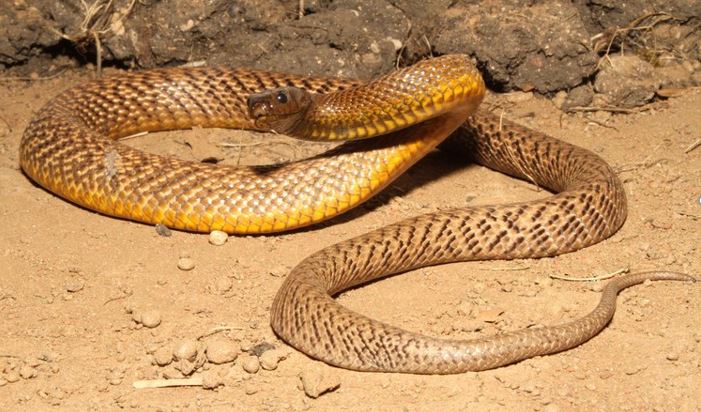
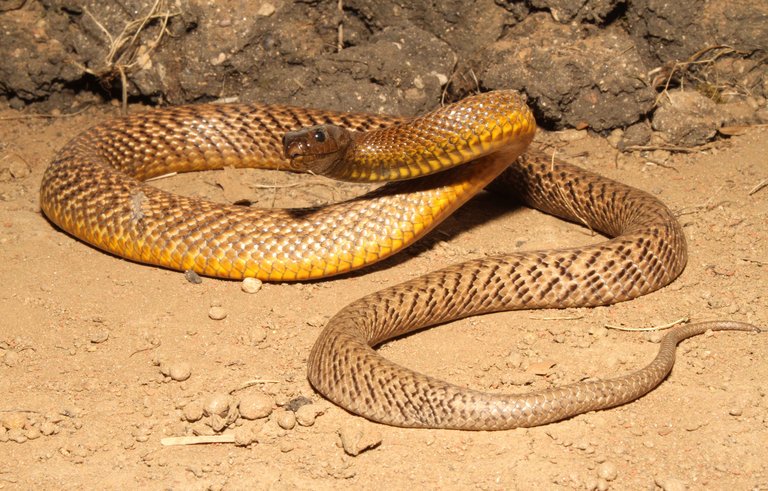
The inland taipan[iv]

For a timid and rarely seen snake, in recent years the inland taipan has garnered a fearsome reputation for itself. In fact, one of its alternative names is the fierce snake, but this is entirely due to its venom, milligram for milligram the most lethal of any of the world’s reptiles. It is often reported that the venom from a 110 mg bite, if carelessly (or maliciously) injected, could kill 100 adult men. The fact that the average dose delivered by an inland taipan is about 44 mg is rarely mentioned, although since this is still enough to kill at least 40 adult men it could be argued I’m being pedantic. Compare this to the most lethal member of the saw-scaled vipers[v], which can reportedly kill six adult males with the amount of venom it delivers with one bite. (We’ll be returning to the saw-scaled viper a little later.)

The chance of encountering the inland taipan, which inhabits that semiarid corner of hell-on-earth between Queensland and South Australia, is vanishingly small. Indeed, in Australia your chance of dying from thirst or a camel stampede is probably greater than dying from a snake bite from any species. It’s also worth noting that the inland taipan has been described as placid and reluctant to strike; of course, if cornered or mishandled it will not hesitate to bite with remarkable speed and precision, and more fool you.

The sea wasp[vi]

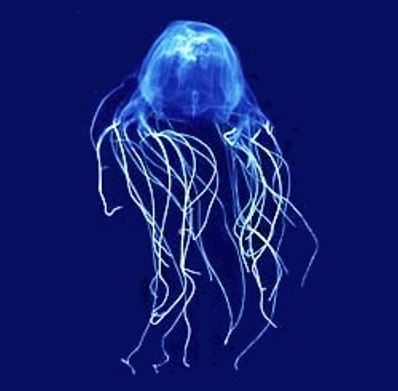
The sea wasp is another matter altogether, not because it is remotely vicious, but because it just doesn’t give a damn. All envenomations are accidental. The largest of the box jellyfish, it spends its life floating in the warm tropical waters off northern Australia, Papua New Guinea and Southeast Asia. Well, floating isn’t entirely correct. The sea wasp does swim, but not in the determined way that would get it a place in Australia’s Olympic swimming team; apparently at full pelt they can cover about six metres in a minute. In the right season and the right place, the chance of accidentally bumping into one of these almost transparent jellyfish is depressingly high. Beaches all along the northern, tropical shorelines of Australia have signs warning swimmers of the danger.

Sea wasp.
Photo Creative Commons

An adult sea wasp is made up of a roughly square-shaped bell about 30 centimetres in diameter; 15 tentacles trail from each of the bell’s corners, each of which can be up to three metres long and are covered in around 5,000 cells called cnidoblasts, each of which in turn houses a nematocyst, which is Latin for ‘this will hurt’.[vii]

Nematocysts are the business end of a sea wasp’s venom delivery mechanism. When its prey, usually prawns or small fish, brush against the tentacles, the cnidoblasts release the nematocysts. The nematocysts penetrate the skin of the victim like miniature harpoons and then release their venom. Despite having actual eyes, the sea wasp seems incapable of restraining the cnidoblasts from releasing their load if the tentacles accidentally brush against something which isn’t prey, such as a human. Since this means the sea wasp is missing out on a meal and must now spend what I assume is a lot of energy to rearm the cnidoblasts, this is a serious design fault. Admittedly, that’s small comfort for anyone writhing in the water in unbearable pain, but one can only imagine the cuss words going through what passes for a sea wasp brain.[viii]

According to one study[ix], a sea wasp carries enough venom to kill 60 adults, which considering its size compared to, say, the inland taipan, is some achievement. Nonetheless, most encounters with a sea wasp don’t end with a fatality. The quick application of vinegar to neutralise any nematocysts still attached to the skin, and ice to relieve the pain, is often all that’s necessary. Having said that, one study[x] shows that 8% of envenomations require hospitalisation:

‘Because of the rapidity of fatal C. fleckeri envenoming, the critical window of opportunity for potentially life-saving use of antivenom is much smaller than that for snake envenoming, possibly only minutes. Furthermore, from animal study data, it was calculated that around 12 ampoules of antivenom may be required to counter the effects of a theoretical envenoming containing twice the human lethal dose of venom.’

The lesson here is if you come across a sign at a beach that says beware of box jellyfish (or for that matter crocodiles) consider something marginally safer and decidedly less painful for your daily outing, like jumping off a cliff.

The Sydney funnel-web spider[xi]

I’m an arachnophobe, and this spider pretty well defines the content of my worst nightmares.

I readily admit I’m scared of vampires, malevolent ghosts, land sharks, Brussel sprouts and omelettes – for that matter, any food made mainly from eggs – but my fear of spiders is on a whole other level. Even if I catch a glimpse from the corner of my eye of the completely innocuous daddy longlegs a long shiver will pass down my spine. I don’t know what it is about arachnids that gets me all goosebumpy or triggers my fight or flight instinct (to be honest, my fly or fly-twice-as-fast instinct), but it might have something to do with spiders like huntsmen, wolf spiders, tarantulas and funnel-webs being so damn hairy. It just isn’t right; it’s as if they’d killed a dog or cat, skinned it and donned the fur. Then there’s the eight legs. Six legs on creatures such as ants and earwigs are hard enough to put up with, but eight seems a serious case of overengineering.

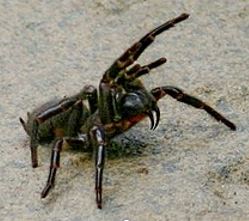
Sydney funnel-web.
Photo Creative Commons

Anyway, of all the world’s spiders, the Sydney funnel-web ticks every yuck box: wears dog fur, tick; eight legs, tick; lives in a hole in the ground, tick; likes entering human households, tick; has more than two eyes, tick; has fangs long enough to pierce your toe nail to get to the vulnerable flesh underneath, tick; can kill you with single bite, tick.

Indeed, I cowrote a short story about the Sydney funnel-web with good friend, colleague and fellow-arachnophobe Sean Williams. The story, ‘Atrax’, must have hit a nerve with quite a few people: it won the Aurealis Award for best horror short story in 1999.

The Sydney funnel-web’s lethality can be put down to an extraordinary compound in its venom called δ-atracotoxin (sometimes referred to as delta-hexatoxin[xii]), which bizarrely is brilliant at killing its normal prey of insects, but in small doses causes no harm to mammals … with the single exception of primates. And humans, regrettably in this single instance, are primates. Why the venom should be so damn selective is anyone’s guess, and there have been a few.[xiii]

The other peculiar fact about the Sydney funnel-web is that the male’s venom is up to six times more toxic than the female’s[xiv]. The best theory to explain this is that the male goes wandering during the mating season looking for females and has to defend itself against hungry predators, as hard as it is to imagine any predator being so hard up it needs to feed on such an ugly, hairy and extraordinarily venomous assassin. Admittedly, this doesn’t quite explain why the venom is so effective against primates; I assume almost every human on the continent, like myself, would go to great lengths to avoid antagonising any spider let alone one that can kill you, and as far as I know, humans are the only primates to have made their home in Australia.

Ultimately, the venom’s ability to kill humans is just an accidental byproduct of its evolutionary development.

But, and this is a big ‘but’, no human has died from the bite of a Sydney funnel-web spider since an antivenom became available in 1981.

Most venomous versus most dangerous

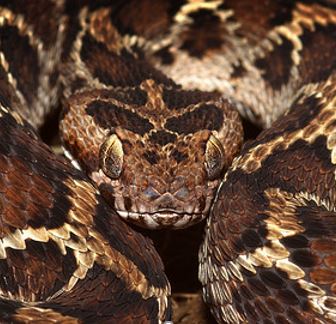
And this is where we return to the saw-scaled viper. One of these smallish snakes, the largest will grow no bigger than 90 cm, may only be able knock off six fully grown adults, as opposed to the inland taipan’s potential 100 victims, but nonetheless, to my mind the viper is the more dangerous of the two snakes.

Before I set out my reasons for this, we should remember the saw-scaled viper and the inland taipan only have to kill you once to ruin your day, not six or a hundred times, which would seem – and please excuse the pun – something of an overkill. As far as the average human is concerned, a bite from either of these snakes will see your life flashing before your eyes.

And why do I think the saw-scaled viper is the more dangerous of the two?

First, your chance of encountering a saw-scaled viper on its home turf – anywhere dry in Africa, the Middle East and southern Asia – is dramatically higher than your chance of encountering the inland taipan on its home turf.

Saw-scaled viper.
Photo Creative Commons

Second, the saw-scaled viper is a much testier beast than the inland taipan, and seems inclined to bite anyone passing within striking distance, something the inland taipan is not inclined to do.

Third, your chance of getting good medical care through much of the saw-scaled viper’s range, let alone the appropriate antivenom, can be very small.

Indeed, the saw-scaled viper may be responsible for more human deaths than any other snake, whether we’re talking about other vipers, adders, taipans, cobras, rattlesnakes, kraits or mambas. It’s reported to be responsible for up to 90% of all snakebites in Africa.[xv]

But rather than picking on any one snake, it’s important to understand that snakebites are a serious health problem in most developing countries. According to the World Health Organization[xvi]:

‘Worldwide, up to five million people are bitten by snakes every year. Of these, poisonous (envenoming) snakes cause considerable morbidity and mortality. There are an estimated 2.4 million envenomations (poisonings from snake bites) and 94 000–125 000 deaths annually, with an additional 400 000 amputations and other severe health consequences, such as infection, tetanus, scarring, contractures, and psychological sequelae. Poor access to health care and scarcity of antivenom increases the severity of the injuries and their outcomes.’

It seems to me these statistics, which barely reflect the pain, misery and social desolation that can be caused by a snakebite, are the ones we should obsess over, rather than how many humans can be killed by a single and remarkably shy Australian snake.

One final point. On average, more Australians die each year from the stings and bites of ants, wasps, bees and ticks than snakebite, largely thanks to anaphylactic shock (and not prophylactic shock as I once tipsily declaimed). From 2000 to 2013, 27 Australians died from snakebite; over the same period, 32 Australians died from animals that fly and crawl around us every day of our lives without us giving them a second thought. In the same period, no one died from a spider, scorpion or centipede bite, and only three people died as a result of envenomation from a marine creature[xvii].

To put these statistics into proper perspective, horses were responsible for the deaths of 77 Australians between 2000 and 2010[xviii]. To make the perspective even sharper, consider that between 2000 and 2013, more than 21,000 Australians died in car accidents[xix].

By the way, in those same thirteen years, two people were recorded to have died from an unknown animal or plant. I’m betting it was a drop-bear.


[i] Genus Carukiidae.

[ii] Pseudechis australis.

[iii] Thylarctos plummetus – in my humble opinion, the best species name ever.

[iv] Oxyuranus microlepidotus.

[v] Echis carinatus.

[vi] Chironex fleckeri.

[vii] Disappointingly, and rather mundanely, nematocyst is Latin for ‘a cell with threads’.

[viii] In fact, sea wasps don’t have a brain as such, or anything else we might recognise as a central nervous system. But it does have something: ‘The box jellyfish’s nervous system is more developed than that of many other jellyfish. They possess a nerve ring around the base of the bell that coordinates their pulsing movements … ’ See https://en.wikipedia.org/wiki/Box_jellyfish.

[ix] http://emedicine.medscape.com/article/769538-overview

[x] https://www.mja.com.au/journal/2005/183/11/prospective-study-chironex-fleckeri-and-other-box-jellyfish-stings-top-end#authors

[xi] Atrax robustus

[xii] For example, see:

https://theconversation.com/i-didnt-mean-to-hurt-you-new-research-shows-funnel-webs-dont-set-out-to-kill-humans-146406

[xiii] For an explanation that makes sense to me, see: https://biology.stackexchange.com/questions/8825/why-is-funnel-web-spider-venom-so-lethal-to-humans-and-not-so-much-for-other-mam

[xiv] https://en.wikipedia.org/wiki/Delta_atracotoxin

[xv] James Cook University toxinologist Professor Jamie Seymour carefully lays out what makes one venomous animal more dangerous than another in the National Geographic documentary World’s Worst Venom, not only comparing and ranking the inland taipan with other snakes, but also including sea stingers, spiders, scorpions and many other venomous creatures. Well worth a look if you can get your hands on it. See:

https://www.imdb.com/title/tt1132196/?ref_=rvi_tt

[xvi] https://www.who.int/en/news-room/fact-sheets/detail/animal-bites

[xvii] https://biomedicalsciences.unimelb.edu.au/news-and-events/archive-news/professor-daniel-hoyer-and-dr-ronelle-welton-featured-academics-in-pursuit-article

[xviii] https://www.australiangeographic.com.au/topics/wildlife/2016/03/here-are-the-animals-really-most-likely-to-kill-you-in-australia/

[xix] https://en.wikipedia.org/wiki/List_of_motor_vehicle_deaths_in_Australia_by_year

06 April 2020: Possible new date for arrival of Homo sapiens in Australia

In an earlier blog I mentioned a letter to Nature that suggests up to 2% of the Papuan genome originated ‘ … from an early and largely extinct expansion of anatomically modern humans (AMHs) out of Africa.’

If correct, this is important because it pushes back the earliest currently accepted dates for the human occupation of Australia (well, Sahul back then) beyond 50,000 – 60,000 years.

New evidence for a possible earlier date has now come from a site near Warrnambool, a town on the southwest coast of Victoria, where scientists have been investigating a site at the mouth of the Hopkins River. In a paper from CSIRO, it is described as an ‘erosional disconformity of last Interglacial Age’ where the shells of edible molluscs and transported stones were discovered.

Hopkins River mouth

The mouth of the Hopkins River. (Photo from Warrnambool local government website.)

It is not known for sure whether humans or animals such as seabirds made the formation, but the site has been confirmed as a midden, and evidence for fire damage to the stones suggests they may have been used to make a hearth.

Thermoluminescence analysis of the stones, together with independent stratigraphic evidence, suggests the hearth could date back between 100,000 – 130,000 years.

If true, not only does this double the possible dates for the earliest occupation of the Australian landmass, it also considerably pushes back the earliest currently accepted dates for the first successful emigration – an emigration resulting in living descendants – of AMHs out of Africa by as much as 20,000 – 50,000 years.

(The research was presented to the Royal Society of Victoria by, among other academics, Jim Bowler, who discovered Mungo Man in 1974. The Guardian’s Paul Daley wrote about the paper and interviewed Bowler in March last year. Also, see this from the Royal Society of Victoria’s own website.)

24 August 2018: When did humans first leave Africa?

This blog post is titled ‘When did humans first leave Africa?’ I confess, it’s a trick question, but we’ll come back to that later.

So to start with, let’s attempt to answer not a trick question but a trickier question: when did Homo sapiens first reach Australia?

This has been a contested debate for several decades, with proposed dates stretching from 75,000 years ago to 40,000 years ago. The bottom mark was established by the dating of the remains of Mungo Man, the oldest remains  of anatomically modern humans (AMH) yet found outside Africa.

Mungo Man

Mungo Man

Towards the upper end, luminescence dating of sediments around artefacts recently found at Madjedbebe in the Northern Territory give a date of around 65,000 years, although this is contested.

In a recent article in The Conversation, ‘When did Aboriginal people first arrive in Australia?’, authors Alan Cooper, Alan N. Williams and Nigel Spooner state the ancestors of Aboriginal Australian first reached Australia sometime between 50,000 and 55,000 years ago, just after AMH left Africa.

This date comes from geneticists working on Neanderthal ancestry in the modern human genome. In ‘Tracing the peopling of the world through genomics’, authors Nielsen et al. write that:

‘All non-African individuals studied so far contain around 2% Neanderthal ancestry, suggesting that admixture mostly occurred shortly after the dispersal of anatomically modern humans from Africa … the date of hybridization has been estimated to be approximately 50–65 kyr ago …’

33.1 H. neanderthalensis Amud 1 0.4-0.04 mya

Cast of H. neanderthalensis (Amud 1) from the Australian National University. Photo: Simon Brown

This date is now generally accepted by palaeoanthropologists.

But that presents us with a quandary. As I wrote in an earlier blog, fossils from the cave of Jebel Irhoud in Morocco, together with genetic data from a 2,000 year old Khoe-San skeleton, suggests our species arose in Africa at least 300,000 years ago. So why did it take our species a quarter of a million years to find the exit?

Well, as it turns out it, it didn’t.

In a January 2018 report in Science, authors Chris Stringer and Julia Galway-Witham note that recent fossil evidence from Israel suggests our species had left Africa by 180,000 years ago. The report also recounts genetic analyses of Neanderthal fossils from two caves, Denisova in Russia and Hohlenstein-Stadel in Germany, that ‘indicate at least one earlier phase of introgression, from H. sapiens into Neandertals … estimated at 219,000 to 460,000 years ago’.

At this stage, it seems that AMH could have left Africa over 200,000 years ago, and yet DNA evidence strongly suggests the ancestors of all non-African members of our species left Africa no earlier than 60,000 years ago.

So what’s going on?

Nielsen et al. write that the latter date indicates when the ‘ultimately successful’ dispersal of H. sapiens from Africa occurred. In other words, those members of our species who left earlier are now extinct and left no trace in our genetic record.

Stringer and Galway-Witham write that there is evidence there were several humid phases between 244,000 and 190,000 years ago. But these phases were bracketed by severe periods of aridity, which meant ‘the region was probably more often a “boulevard of broken dreams” than a stable haven for early humans.’

Chris Stringer

Chris Stringer, Research Leader in Human Origins, Natural History Museum

On the other hand, a letter published in Nature in 2016 suggests that earlier migrations of H. sapiens from Africa may have left their mark on some of us after all; specifically, Papuans.

After analysing ‘a dataset of 483 high-coverage human genomes from 148 populations wordwide … ‘ Pagani et al. found ‘ … a genetic signature in present-day Papuans that suggests that at least 2% of their genome originates from an early and largely extinct expansion of anatomically modern humans … out of Africa.’

This brings us back to the article in The Conversation. Cooper et al. discuss how Aboriginal Australians moved to and occupied Australia around 50,000 years ago. Of course, 50,000 years ago it wasn’t Australia, it was Sahul, a single landmass comprising Australia, Tasmania and Papua New Guinea.

Sahul

Sahul

Yet the letter in Nature suggests that Sahul might in fact have been occupied by H. sapiens before that date. Its authors hypothesise either that these people came from an unsampled archaic human population that split from modern humans ‘either before or at the same time as did … Neanderthal’, or that they were a modern human population that left Africa ‘after the split between modern humans and Neanderthals but before the main expansion of modern humans in Eurasia’.

The data from all this research is sometimes confusing and contradictory. Over the last quarter century palaeoanthropology has undergone a great revolution driven partly by discoveries of new hominin fossils (eg H. floresiensis and H. naledi), and partly by new and refined techniques in analysing DNA. There is a lot of data to sort through, doublecheck and assess. Nevertheless, as measurements are refined and new discoveries are made, we learn more about our past and so more about ourselves.

#

So, why is the header a trick question?

H. habilis

Homo habilis

All the above information deals with the history of just one species, our own. But H. sapiens were not the first humans to leave Africa. For example, some members of H. heidelbergensis left Africa around half a million years ago, evolving into H. neanderthalensis in Europe. Those that remained in Africa almost certainly gave rise to H. sapiens.

And if the conclusions of a recent paper by Argue et al. studying the phylogeny of H. floresiensisis are correct, then another and possibly earlier human migration out of Africa occurred. This species’ forebears are closely related to H. habilis, the oldest species in our genus, Homo.

It’s almost as if the need to migrate is as defining a feature of our genus as bipedalism, a large brain and an opposable thumb.

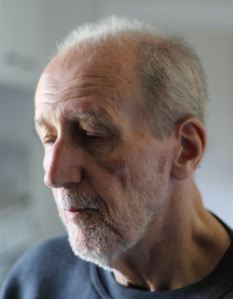
14 December 2017: Colin Groves (24 June 1942 – 30 November 2017)

1

My friend Colin Groves died two weeks ago this day. It came a surprise, although I knew he was in palliative care. He seemed invincible as those with a great intellect always seems invincible, as if death could be put off indefinitely. Although aged he was never an old, and although physically ill his mind was as sharp as an Acheulean hand-axe.

In a real sense his work makes him immortal, at least as far as any human can be immortal. I knew him chiefly as a friend and fellow skeptic, and more recently as a co-writer. Although I had some knowledge of his standing among taxonomists, anatomists, biological anthropologists, primatologists and palaeontologists, he was overwhelmingly modest. Just the preceding list of fields should give you some idea of the breadth of his knowledge.

When Jane Goodall was asked what it felt like to be the world’s foremost primatologist, she replied ‘You’re mistaken. The world’s foremost primatologist is Colin Groves.‘[i]

At his funeral, colleague Professor Kristofer Helgen noted that Colin had named more than 50 new kinds of mammals, and that the first, the Bornean Rhino, remains the largest living mammal described in recent generations.[ii]

‘Colin was the most influential large-mammal taxonomist of the last half-century. His discoveries and impacts are astonishing … The last species he named, in a paper which appeared … in the last month of his life, was the Tapanuli orangutan, one of only eight living great apes on our planet … ‘

As Professor Helgen points out, Colin is probably best known for describing Homo ergaster in 1975, together with Vratislav Mazák. Homo ergaster, which lived in Africa between 1.4 and 1.9 mya, was probably one of our direct ancestors.

3

Homo ergaster. ANU cast of cranium KNM ER 3733, discovered at Koobi Fora, Kenya, in 1975 by Bernard Ngeneo.

Professor Helgen said Colin Groves was an original.

‘He was a gentle soul, but could be an immovable opponent. And he was genuinely brilliant, yet every bit as genuinely modest … When I think of Colin, I see him in my mind’s eye in his office at the ANU, decked from floor to ceiling with books and journals and reprints, all of his key resources, usually reckoned obscure to all others, within arm’s reach.’

This rings a cathedral of bells. Whenever something came up in our conversation about – well, almost anything – Colin would have a book, journal or anecdote to clarify, correct or corroborate any fact, no matter how obscure.

But my overriding memory of Colin isn’t his intellect or reputation, but his enormous kindness and placidness. He was never overtaken by anger, only bewilderment at the occasional fecklessness or waywardness of his fellow Homo sapiens.

He was one of my dearest friends, and his passing leaves a gaping hole in the lives of everyone who knew him.

Below is the eulogy I delivered at his funeral last Thursday.

Colin Peter Groves

As I look up at the Canberra’s first blue sky in five days, I’m tempted to think that while Colin did not believe in god, god almost certainly believed in Colin.

Although I knew him for 30 years it wasn’t nearly long enough, but perhaps long enough to discern the three great loves of his life.

Most importantly of all, his partner, best friend, constant companion and carer, Phyll.

Second, his love of science, particularly biology of course, and how it revealed to him the universe he shared with his fellow-primates, ungulates, big cats, avian dinosaurs, tardigrades, dogs, bats and cetaceans.

Third, his love of chinwagging. All the creatures I just mentioned could happily be included in a single lunchtime conversation with Colin. You might start discussing sexual dimorphism among species of African antelope and end by discussing the size of Donald Trump’s genitalia. (Amazingly, and somewhat distressingly, size does matter in nature.)

Let me deal briefly with each of these three great loves, from last to first.

It seemed to me that Colin was in his element when he shared conversation with friends and colleagues. If food and drink were included, so much the merrier, which added a cruel twist to the illness that eventually took him from us.

Although most discussions started with and usually revolved around science, his interests were catholic: skepticism, history, music, art, literature, film and television, and a hundred other subjects. He didn’t possess a ‘comfort zone’ as such; he was happy drifting on a sea of titbits, anecdotes, quotes, and bad puns (because, as Colin would patiently explain, a good pun isn’t a pun but a joke, and the quality of a pun is directly proportional to the volume of the groan it elicits).

He also had a deep and abiding love for startling and unexpected facts.

I remember how much he enjoyed discovering that the Great Pyramid of Khufu, built around 2560 BC, was the tallest building in the world until succeeded by – of all things – Lincoln Cathedral in 1311. A 3,800-year old record. He was just as delighted to learn that when Lincoln Cathedral’s centre spire collapsed in 1549, the Great Pyramid couldn’t resume its title as the world’s tallest building because erosion had reduced its height to below that of a church in Germany.

While an hour’s conversation with Colin could be filled with minor revelations such as these, they were never random thoughts. They were either staging posts that guided you safely to the end of a conversation, or points that illustrated a greater truth Colin was pursuing with the gentle doggedness of a modern-day Socrates.

In a conversation about intelligence and self-awareness, he might include the latest research about the Theory of Mind among corvids, Mozart’s Marriage of Figaro, gorillas studying their reflection in mirrors while trying on different hats, and the British television series Peaky Blinders. But every diversion would have a point, and every point would add weight in support of an argument for or against a main proposition.

I briefly mentioned Donald Trump. It seemed to me that while Colin never avoided discussing politics, what he cared about were the issues important to all of us in a free and democratic society, issues shaped and sometimes decided by politicians, pundits and lobbyists. It was people that Colin cared about, not cant. It was ideas Colin cared about, not ideology. What Colin wanted for our society was equality, opportunity, fairness and boundless curiosity.

Colin’s second great love was science, particularly anthropology and taxonomy. To say he was a biological anthropologist, while absolutely accurate, is entirely insufficient. Robert [Attenborough] has already talked about Colin’s amazing academic career, but I first met Colin because of his opposition to those forces that set themselves against science, particularly religious inerrancy, with a special focus on the shallow, silted stream of creationism.

From the first time I attended a meeting of the Canberra Skeptics, Colin immediately stood out as the most determined, the most knowledgeable and the most resilient opponent of creationism I have ever encountered. I never imagined someone as steeped in science as Colin would also be so utterly familiar with the Christian bible he could quote chapter and verse.

It wasn’t the idea of opposition that excited him, but the idea of investigating claims and when found wanting, standing up against them. I never once saw Colin angry, at least not in the sense most of us would understand the word, but when confronted by blind stupidity or blind faith, his eyes would open slightly in surprise, then narrow as he marshalled his arguments in defence of rationality.

The only other time I saw this response was when he was confronted by casual arrogance, wilful pride or careless prejudice. He understood how all these were used to stifle debate or to keep underdogs in their place, and he resented it.2

Colin was not a skeptic for the sake of it. It was just the flipside of the scientific method he applied to his everyday investigations of the natural world. It was as much a part of him as that sense of wonder that shone from him whenever he talked about the discovery of a new hominin fossil, or a new species of orangutan, or gravity waves.

Ultimately, forever and always, Colin’s greatest love was Phyll. On those few times I visited when Colin showed off just how much he knew about obscure science or history or culture, he wasn’t doing it to impress me. I think he was doing it because he just loved flirting with Phyll.

Phyll was his touchstone and keystone, his measure and the source of his strength. When she spoke, he listened. Even when he disagreed, he listened, and he listened closely.

And one never visited Colin, one always visited Colin and Phyll. They were as close to being a single unit as any two people I’ve ever met. Two minds, two voices, often two very different opinions, but a single soul, a word even Colin would agree with in this context.

They generously shared their life with family, friends, colleagues and students.

For that I will always be grateful.

[i] Mittermeier, Russell A. & Richardson, Matthew. Foreword to Extended Family: Long Lost Cousins, by Colin Groves. Conservation International, Arlington, 2008.

[ii] Helgen, Kristofer M. 2017. ‘Eulogy for Colin Peter Groves’, Canberra, 7 December.

09 November 2017: the eighth great ape and the problem with ‘species’

Until recently, only seven species made up the group of primates known as the great apes, or Hominidae. Two orangutan species (Sumatran and Bornean), two gorilla species (eastern and western), two chimpanzee species (chimpanzees and bonobos), and us.

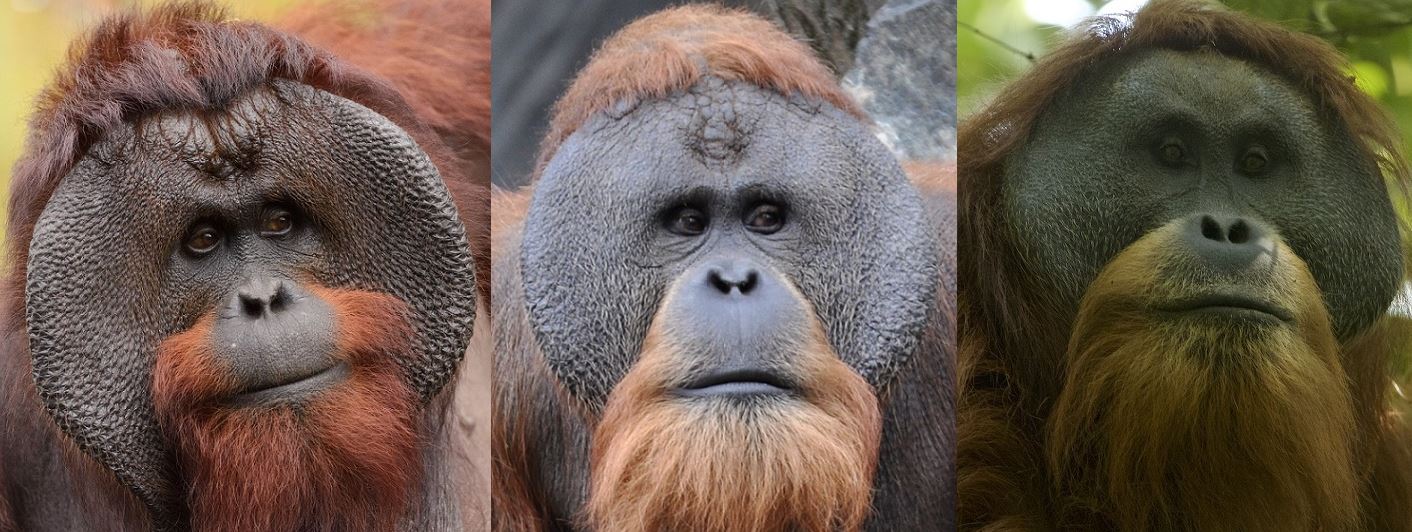
But in a report recently published in Current Biology, an international team of scientists announced a new hominid with fewer than 800 members, Pongo tapanuliensis, found just south of Lake Toba in Sumatra. To save your tongue twisting around that particular binomen, we can call it the Tapanuli orangutan.

The scientists compared skull, jaw and dental characteristics of a Tapanuli specimen with those of the Sumatran and Bornean species, and analysed 37 orangutan genomes as a second line of evidence.

Orangutan

Three species of orangutan: from left, Bornean, Sumatran, Tapanuli. Photo credits: Eric Kilby, Aiwok, Tim Laman

The report gained a great deal of media attention: not only because we humans had a new cousin, but because the Tapanuli is an endangered species.

However, there were dissenting voices. In an interview with the ABC, for example, Lee Christidis from Southern Cross University pointed out that the analysis had been carried out on only one specimen and that the DNA evidence was at best ambiguous.

It’s only fair to point out that it’s often the case that a species will be described by a single representative organism, or, as happens frequently in palaeontology, those fragments of a single organism that have been fossilised or otherwise survived over many millions of years.

The report also generated discussion about what we mean by the word ‘species’. Jerry Coyne, professor emeritus at the University of Chicago and author of the excellent Why Evolution is True, wrote in his blog:

‘Not only do I see this new “species” as merely an isolated and genetically differentiated population (as are many human populations regarded as H. sapiens), but I’d also contend that there is only one species of orangutan overall, with these three groups all being subspecies. Sadly, a lot of systematists don’t see it that way, as they seem to think that any isolated population, if it can be told apart morphologically or genetically from others, warrants being named as a new species. Yet to evolutionists, a “species” is not an arbitrary segment of nature’s continuum, but real entities that maintain their “realness” because they don’t exchange any (or many) genes with other such entities where they cohabit in nature.’

But is this indeed the definition of species with the greatest currency among most biologists?

To start with, there has to a definition that works across all fields. A primatologist cannot have a different concept of species from, say, an entomologist, or the whole point of taxonomy – the orderly classification of living things that demonstrates their evolutionary relationships – starts to fall apart.

This doesn’t mean that definitions in biology – or any scientific endeavour, for that matter – are written in stone. As our knowledge of the world around us grows, the language we use to explore, explicate and explain that knowledge must also grow.

The definition I was taught at school is not dissimilar to Coyne’s quoted above, and is based on what is called the Biological Species Concept (BSC), developed by Ernst Mayr and Theodosius Dobzhansky in the early 1960s (Coyne did some graduate work under Dobzhansky at Rockefeller University). As Colin Groves, professor emeritus at the Australian National University, wrote, ‘This concept states that under natural conditions a species ‘should not exchange genes with other species’[i]. Groves goes on to point out that ‘ … the popular idea that two species are “unable” to interbreed is  a misunderstanding: it is not that they cannot interbreed, it is that they do not.‘

The BSC was further refined by Mayr and Jared Diamond in a paper on Melanesian birds in 2001, and then in 2004 by the aforementioned Jerry Coyne with H. Allen Orr in a book about speciation called, appropriately enough, Speciation.

Groves argues that the modified definition of BSC risks different standards of comparison in different taxonomic groups: it’s a definition that won’t work across different fields, in other words.

Groves again: ‘If a genus contains a pair of sympatric[ii] sibling species (species that differ only slightly, inconspicuously), the standard for species recognition will be set much “lower” than in a genus in which sympatric species pairs are grossly different. It is the search for objective standards – for an operational means of distinguishing species – that has been responsible for the controversies that marked taxonomic discussions over the past 15 or 20 years.’[iii]Taxonomy

Many biologists now use what is called the Phylogenetic Species Concept (PSC), developed by American biologist Joel Cracraft from the early 1980s. Put very simply, in this concept a species is the smallest population of organisms that is measurably different from other populations sharing the same ancestry. Note that this concept says nothing whatsoever about species sharing genes, such as happened between Homo sapiens and H. neanderthalensis around 100,000 years ago.

It’s important to note that both the BSC and the PSC are attempts to operationalise the evolutionary concept of species; that is, that a species is an evolutionary lineage.

While the report in Current Biology describing the Tapanuli orangutan as a new species of great ape has, for the most part, been received positively, the fact that many distinguished scientists question the findings shows that the debate about what constitutes a species is ongoing.

[i] Groves, Colin. ‘Speciation in hominin evolution’; African Genesis: Perspectives on Hominin Evolution; ed Reynolds, Sally C. & Gallagher, Andrew; Cambridge University Press; Cambridge; 2012, p 46.

[ii] Sympatry occurs when two or more species live in the same geographic area.

[iii] Ibid.

07 October 2017: New evidence suggest we are much older than 300,000 years

In a recent blog I wrote about new dates for skulls found in the cave of Jebel Irhoud in Morocco in the 1960s. Originally assessed as belonging to Homo neanderthalensis (an assessment that was soon challenged), a reappraisal published in Nature this year confirmed they were in fact H. sapiens skulls; the great surprise was that the reappraisal determined them to be at least 300,000 years old.

Jebel Irhoud

Cast of Jebel Irhoud 1 from the Australian National University. Photo: Simon Brown

New work done by scientists in Sweden and South Africa, and reported in Science, have now dated DNA obtained from a 2000-year-old Khoe-San skeleton apparently unmixed with Bantu or Eurasian DNA, as having separated from other H. sapiens sometime between 260,000 and 350,000 years ago.

The San are the First People of South Africa, Botswana and Namibia. Indeed, they may be the First People, the ancestral group all modern humans are descended from, or at the very least very closely related to them.

The San are the most genetically diverse of all humans living today. In an episode of Catalyst on the ABC about her research on San DNA, Professor Vanessa Hayes said, ‘There’s more similarity between myself and a Han Chinese than between two San people.’

Bushman

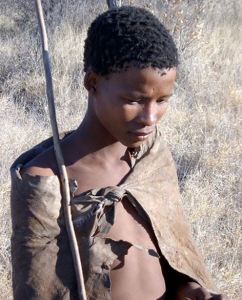
San hunter/gatherer

As reported in Science, the recent work on San DNA involved several ancient individuals, but the standout dates were given by DNA from the genome of a hunter-gatherer boy known as Ballito Bay A. The scientists concluded that, ‘ … our results show that the deepest split among modern humans (the estimated latest time for the emergence of H. sapiens) occurred at between 350 kya and 260 kya.’

Given that the skulls found in Morocco have been dated to at least 300,000 years ago, it would seem not unreasonable to consider the older dates for the emergence of H. sapiens – 350,000 years ago – being closer to the mark than the lower date of 260,000 years ago.

This new evidence also adds weight to the theory that our species may have partly evolved in South Africa.

In the last eight months, we have seen conservative estimates for the age of our species jump from 190,000 years old to almost double that. It’s been an extraordinary year for palaeoanthropology.