Laos

16 April 2024: Dancing Queen

From the Wahiba Sands in Oman to penguin-covered ice sheets in Antarctica, notable events in Aiyana Zinkand’s life have been accompanied by one song, a song that no matter the location, the circumstances or the sheer unlikelihood of there being any music at all, inevitably emerges like a cicada in summer.

ABBA’s 1976 Europop hit ‘Dancing Queen’.
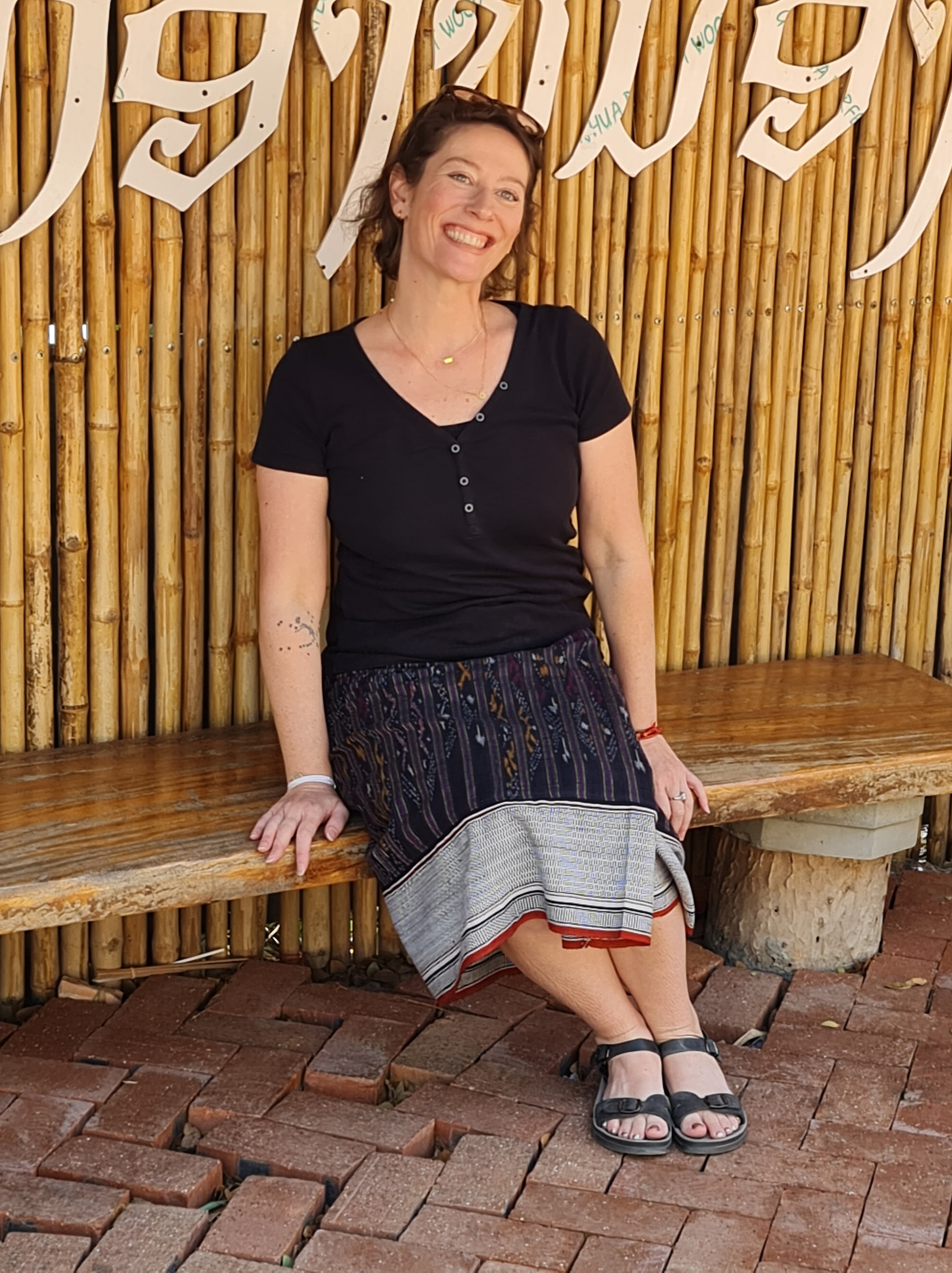
Aiyana Zinkand, Vientiane. Photo: Simon Brown

‘The crazy thing?’ Aiyana says. ‘I can’t stand ABBA – I’m more of a Black Sabbath and Cream fan – and even though “Dancing Queen” came out the year after I was born, it is everywhere.’

In 2016 she was on a camping safari in Borneo with friend ‘Irish’ Katie. They stopped at a cinder block camp somewhere on the border between Malaysia and Indonesia. There was no electricity but plenty of rats. The safari staff provided the entertainment in the Orangutan Irish Bar, basically a jungle football pitch decorated with Chinese and American flags.

‘We were sitting there, literally picking off leeches as we drank warm beer, when one of the Malaysian workers picked up a moisture-sodden and out-of-tune guitar and started playing ‘Dancing Queen’.

‘It was hard to pick out exactly what he was singing because he barely spoke English, but I knew it was “Dancing Queen”. No one else figured it out until the final verse.’

#

Aiyana was born in Baltimore, Maryland. Family dynamics were tricky, and she grew up in Maryland, Michigan and Florida.

‘I was a good kid. Stole a police car once, but otherwise I’ve always been on the straight and narrow. Hard working and very sporty.’

Aiyana’s sport of choice was ice hockey.

‘I was a rep player, but because I was a kid couldn’t play professionally. I hoped to pick up a university sports scholarship and go down that line.’

But then, when visiting her father and grandparents in Florida, she was involved in a car accident.

‘I broke ribs, an ankle and knee cap, and dislocated a few vertebrae. There goes my illustrious sporting career.’

#

‘I’ve been travelling all my life, and I’ve heard “Dancing Queen” in a least 30 different countries,’ Aiyana says. ‘That song is everywhere. And everyone knows it.’

The first time she remembers hearing it as the background musical motif to remarkable events in her life was in a karaoke bar in Budapest around 2005.

‘I was working on the thesis for a master’s degree in economics. I got a grant from the Smithsonian exploring postwar reconstruction in Eastern Europe, comparing cities that had concentrated on either cultural or commercial development. But to make enough money to live and travel on I also worked as part-time chaperone for German students on cultural trip through middle Europe: Germany, the Czech Republic, Hungary and Austria.

‘I was meeting up with them in Prague. It was a cold miserable night with a blizzard howling outside. I got to my accommodation about 10.00 pm, resulting in being yelled at by the landlady for being so late. Her husband handed me a huge key ring with lots of keys on it; I didn’t quite get what they were all for because the man was drunk and I could barely understand him.

‘It turned out my room had been given to someone else, and the room I’d been given instead had no bathroom of its own, hence all the keys. Anyway, I didn’t really know any of this at the time and went to what I thought was still my room, opened door to the bathroom … and there was a naked woman there. She screamed. I screamed. We all screamed.’

After things calmed down and they sorted out who had which room, they got talking. The woman’s name was Susanna. She was Spanish and married to a Swiss banker.

‘She was running away from her husband and using his credit cards to spend all his money. The only things she had with her were a red hat box, a fur coat and a crate of Dom Pérignon. Her plan was to live the high life until her husband realised what she was doing and cancelled the cards, whereupon she would divorce him.

‘She had no transport of her own, so we did a lot of driving around together. Then we hit Budapest. More blizzards. We found an underground karaoke bar that played crappy hits from the 70s and 80s. Then it happened. Susanne started singing “Dancing Queen”.’

#

When she finished school, Aiyana moved to California. To keep body and soul together she did 27 different jobs.

‘At some point I found myself doing legal research work for an environmental lawyer. This is about the time things were really starting to happen for long term environmental issues. I was still bartending at night and serving coffee in the morning. But I was good with numbers and eventually worked fulltime with this lawyer. He paid bonuses in the form of college classes in economics, business, math – stuff related to his business. I became his financial forecaster for projects he was handling.

‘I earned a degree in economics in 2005, one class at a time, and became an expert in my field: RFPs – Requests for Proposal – where the state and federal governments put out tenders for work. So I ended up working for both the government and the private sector.

‘The work was intense. At one point I had projects running simultaneously between Sudan, Kuwait, Argentina and Alaska. At the time I was living in Washington, D.C., and had calls coming in every 45 minutes, 24 hours a day.

‘So here I was working with international budgets, forensic accounting, travelling and kind-of-living in Ethiopia, Sudan and Afghanistan while doing work for the UN …

‘And I burnt out.’

#

‘On one trip I was on an Argentinian ship on my way to Antarctica – work to do with base consolidation – and the captain manoeuvred us close to the ice shelf so we could look at some penguins. To set the mood, for whatever reason, he put a song on the intercom.
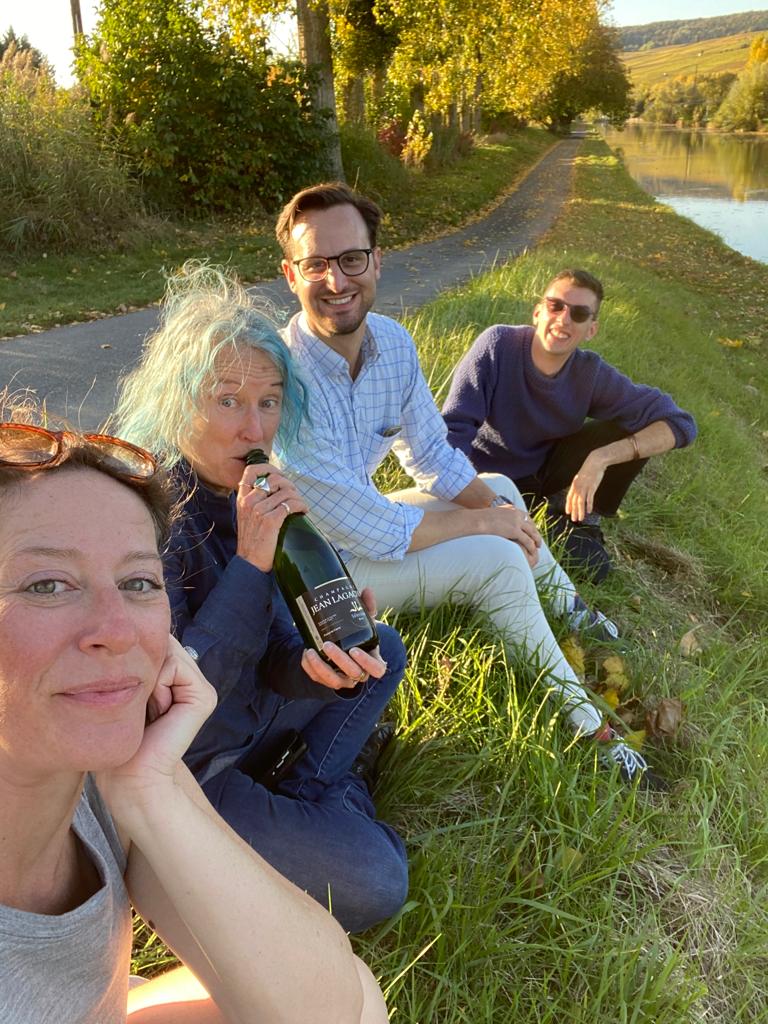
With friends at Aÿ, France. Photo: Aiyana Zinkand

‘You guessed it. “Dancing Queen”.’

Aiyana stresses that sometimes the song was part of normal, even exuberant, events in her life.

‘I remember being in Aÿ, France, with my best friend, drinking champagne and singing “Dancing Queen” at the top of our lungs. This is just one week after leaving Qatar and one day after hearing the song while watching firemen celebrating the start of summer by leaping naked into a canal during the Boat Festival in Leiden. And I heard it recently at the Garage Bar in Vientiane, looking out at a sunset on the Mekong River.

‘So the song’s associated with good events, not just bizarre ones.’

#

Aiyana says it wasn’t just the sheer amount of work alone that got her down.

‘Increasingly, I wanted to do something that honoured my Quaker religion, rather than dealing among other things with the military and weapon contracts, something that started after 9/11.

‘One of the tipping points was when I was involved in final negotiations for a contract dealing with a Senate oversight committee. We were sequestered in a hotel for the duration, which ended up being about 10 weeks. The day we were released I came out of the air-conditioned hotel smack into a heat wave none of us had any idea was going on. It was 109oF.

‘Living like this in my 20s and 30s … well, my life was disappearing.’

She said she had friends who were international teachers who actually ‘lived’ in the places they worked, who interacted with local people and local culture and history.

‘I was visiting one of these friends who taught in Dakar, Senegal. By that time I was thinking about switching from economics to mathematics, which had really started to fascinate me, and career-switching to teaching. It was New Year’s Eve. Fireworks like I’d never seen before. And, of course, running in the background, “Dancing Queen”.

‘I told my friend about my changing interests, and she immediately shouted out to her boss that I wanted to become an international teacher specialising in mathematics. He told me that with my experience – if I got teacher qualifications – a school like his would snap me up.

‘So that’s what I went and did.’

#
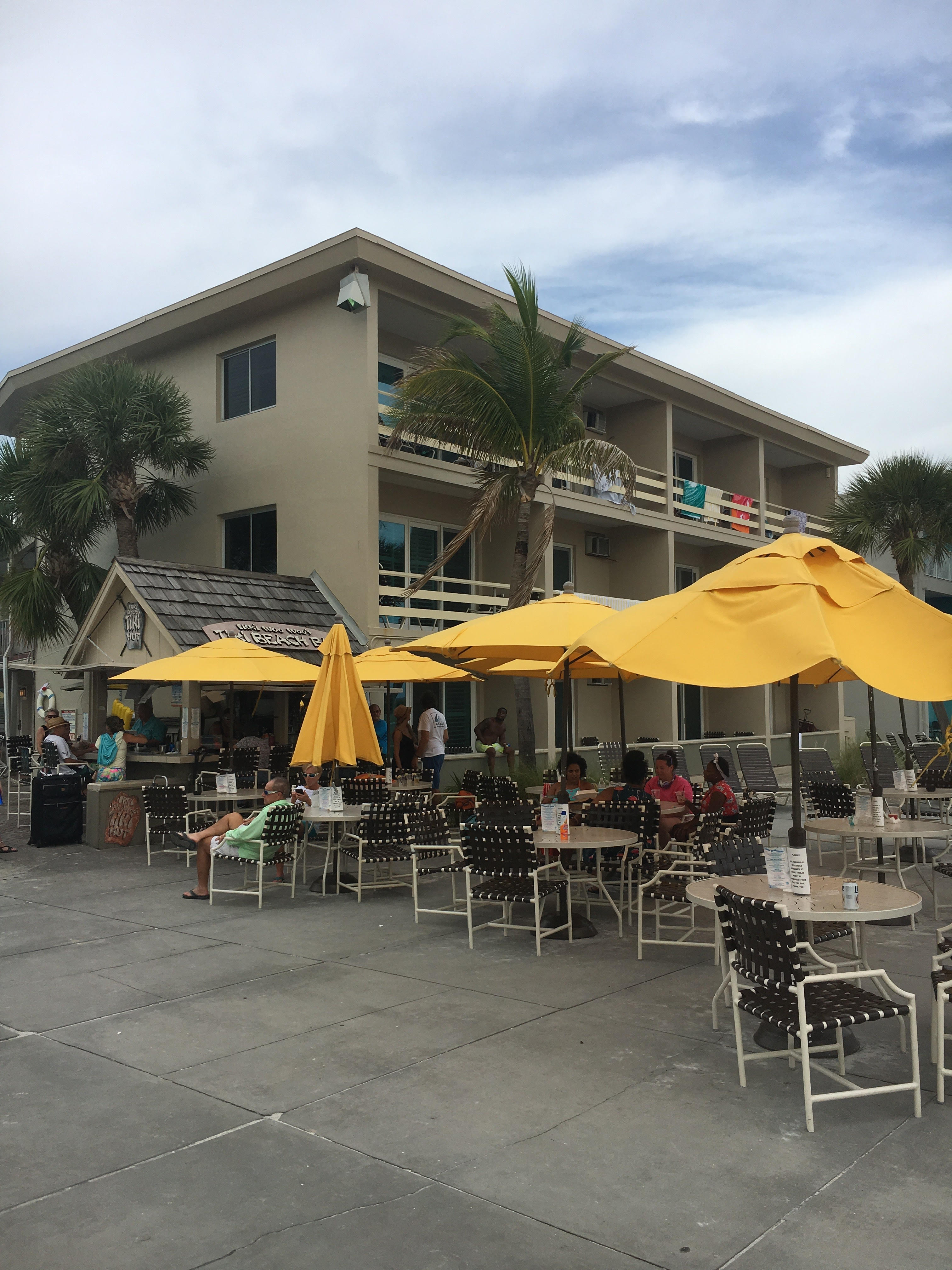
The Ikki Woo Woo Tiki Beach Bar. Photo: Aiyana Zinkand

Every year, Aiyana used to take her dad to Ikki Woo Woo’s Tiki Beach Bar at the Thunderbird Hotel on Treasure Island in Florida, on the coast of the Gulf of Mexico.

‘One time we were there my dad heard “Dancing Queen”. Infuriated, he stood up and shouted: “Fuck Abba!”

‘He then walked off into the sunset, ramrod straight, without his walking cane.’

#

Aiyana did her teaching degree in the US between 2010-2012, ending with her second masters.

‘So I changed my life and became a teacher. I lived and taught in Qatar, and then the Netherlands, and now I teach mathematics to students at the Vientiane International School in Laos.’

#
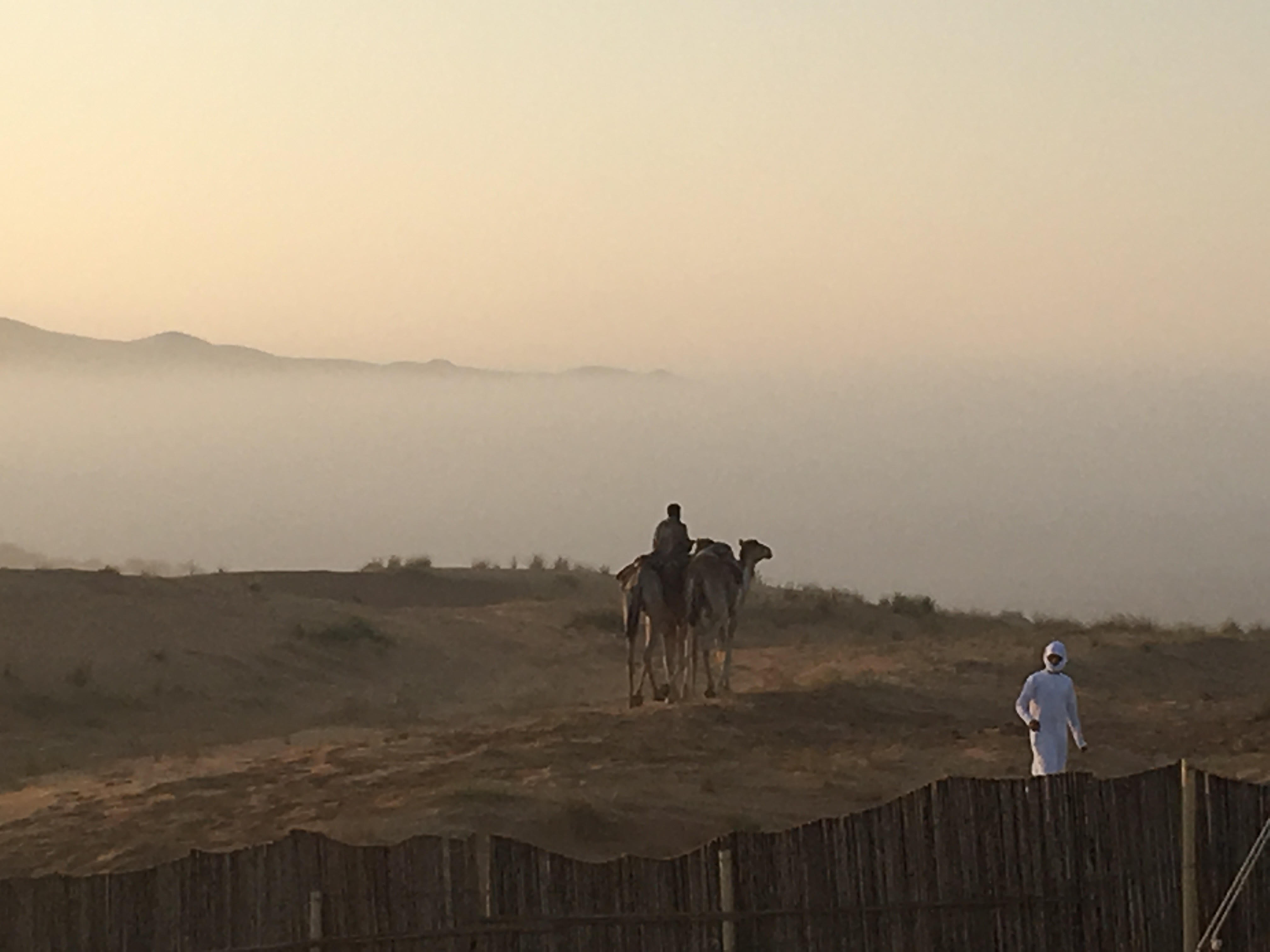
Wahiba Sands, Oman. Photo: Aiyana Zinkand

Aiyana was holidaying in Oman as a last hurrah before leaving the Middle East to live in Europe, and camping in the desert at Wahiba Sands.

‘I got up early so I could watch the sunrise over the desert – one of my favourite things to do. It was 5.00 am.

‘Then I hear it. What the fuck? In the distance I see a camel herder with five camels and a boombox on one shoulder, and blaring out of the boombox was Abba’s “Dancing Queen”.

‘Figures.’
24 January 2024: Vientiane to Wagga Wagga

Since April last year, when I published my last blog post, a great deal has happened in the world of palaeoanthropology: claims and counterclaims about ritual burial for Homo naledi, the discovery of the first structural use of wood (predating the arrival of H. sapiens by some 400,000 years!), and genomic evidence of a severe bottleneck in our ancestors’ population about a million years ago which, according to the scientists who uncovered it, almost spelled the end of us.

Goodbye Vientiane …

Before I move on to these topics, however, an apology. The reason I have not written any posts for such a long time is that 2023 was a year of running around and turning about. AJ and I originally intended to return to Australia from Laos at the end of June last year, but for reasons beyond anyone’s control her replacement at her international school was unable to take up the post. AJ agreed to stay on for another six months, so we ended up staying in Laos until the week before Christmas 2023. We spent six months at the start of the year preparing for the move – selling off goods and packing what we could for coming home – only to find ourselves unpreparing, so to speak, and unpacking and buying good back for an extended stay. That was followed by another six months repreparing, repacking and reselling … well, you get the idea.

… hello Wagga Wagga.

AJ and I are now, however, back in Australia, ensconced in Wagga Wagga for the next year or so. After that, fingers crossed, our last move will be to our ‘always’ home in Mollymook on NSW’s south coast for a long and fruitful retirement. Unless something else happens and we end up moving overseas again …

Anyway, future posts – as in near future posts (promise) – will cover those matters palaeoanthropological listed above. As well, I hope to put up an interview with someone who has led an extraordinary life strangely – even bizarrely – intertwined with Abba’s Dancing Queen.

27 April 2022: Past and present in Xieng Khouang

After American planes had finished their bomb run, a six-year old girl joined others in escaping the cave in the hills of Xieng Khouang where they’d been hiding. But as she and the other children played, one plane returned and dropped one last bomb.

Inside the cave at the Plain of Jars Site 1. The hole in the ceiling of the cave is artificial to let out smoke and let in light. This cave and many like it in Xieng Khouang were used as places of refuge during the Indochina War.

A piece of shrapnel hit the girl in the right leg. Her grandmother, who’d also been outside, was killed outright. Her father carried the girl on his back for 25 kilometres to the cave where a medical team could be found.

That six-year old girl grew up with one damaged leg. She could not labour in the fields like her parents and siblings, nor could she weave. Instead she opened a small store at the junction of three roads in Phonsavan, the province’s capital, selling beer and cigarettes, school exercise books and biscuits, and soap and toothpaste.

Now, 54 years later, her daughter Sakhone Bounthala runs the store and the small pharmacy she herself opened next door.

‘I grew up working in my mother’s shop. It was the last thing I wanted to do when I grew up, so I studied pharmacy. And yet here I am.’

#

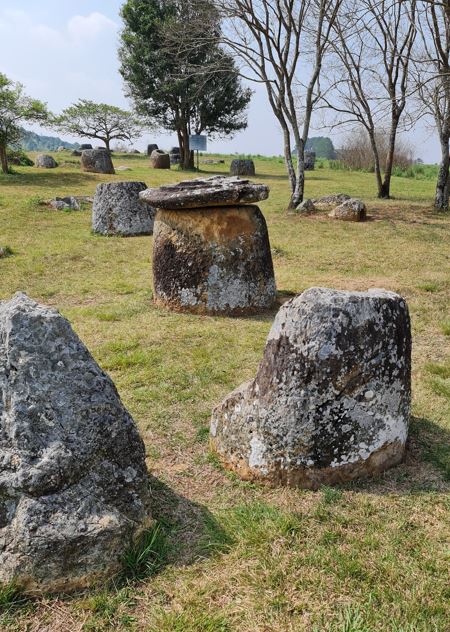
Plain of Jars Site 1.

Xieng Khouang is a province about 200 kilometres north of the Laos capital, Vientiane. For Westerners it is best known  for the Plain of Jars, a megalithic archaeological location of great importance which in 2019 was made a UNESCO World Heritage Site.

The Plain of Jars is set among rolling hills at the end of the Annamite Range, Indochina’s long mountainous spine. The thousands of stone jars that give the place its name were built during Southeast Asia’s iron age, between 500 BC and 500 CE. No one knows who made the jars, although it seems likely they were related to the Hmong population now living in the province, and no one really knows what happened to their civilisation.

#

Sakhone doesn’t just run the pharmacy and general store. With her husband David Deweppe she also operates a bed and breakfast in Phonsavan called PuKyo – Lao for Green Mountain. While David, a Belgian who found his true love and true home in Laos, looks after the guest house, Sakhone takes time from the two stores to take guests on guided tours to the Plain of Jars and other nearby sites.

The PuKyo B&B in Phonsavan, Xieng Khouang’s capital.

The Covid pandemic hasn’t been kind to any country’s tourism industry, but developing countries like Laos have been hit particularly hard. Recently, however, borders are opening up and the flow of tourists is now a steady trickle.

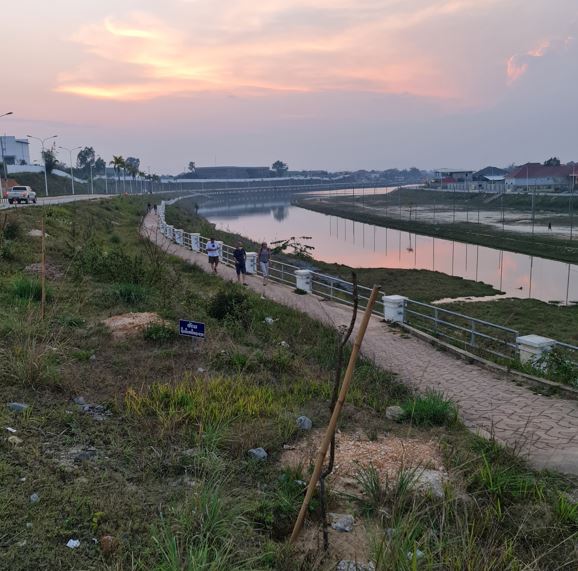
AJ and I were part of a small group of friends that stayed at PuKyo for a brief three days, the first time the guest house had been filled for over two years. During our short visit there was the definite sense that life in Phonsavan was returning to something like normal: the roads were busy with traffic, shops were open, people were frequenting restaurants and cafes and promenading on the walkway around the town’s reservoir.

#

Bomb casings at the Plain of Jars museum.

For the nine year from 1964 to 1973, Laos suffered on average a bombing mission every eight minutes, 24 hours a day. The USA dropped more ordnance on Laos than it did on Germany and Japan during WWII. For the size of its population, Laos is the most bombed country on Earth. Up to 30% of those bombs failed to detonate, and still litter the countryside.

Xieng Khouang was the second most bombed province in Laos. Unexploded ordinance (UXO) contaminates 25% of its villages. Between 1964 and 2008, there have been 50,000 casualties of UXO, and 20,000 of those casualties have occurred  since the Second Indochina War ended in 1974. It’s estimated that over 80 million bomblets (from cluster bombs) remain undetonated.

#

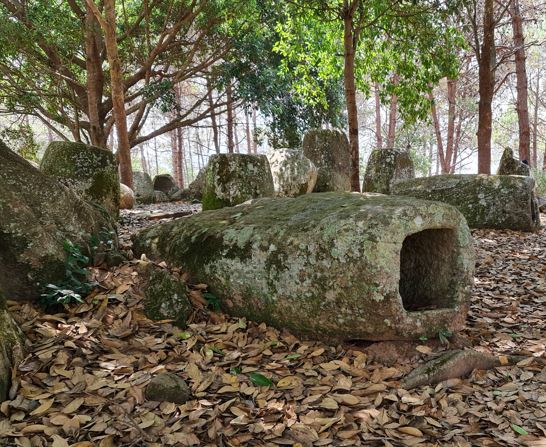
Not all the jars are the same size or shape. These elongated jars can be found at Site 2.

In the 1930s a French archaeologist, Madeleine Colani investigated the Plain of Jars. There are 17 sites in total, scattered over the province, and only the main one, Site 1, is actually located on a plain. The other sites are located on hills or ridges.

Some of the jars have trees growing out of them.

Colani thought Site 1 marked the centre of the civilisation that built the jars, and from the bones, ash and beads she found thought the jars were built to hold cremated remains. Burials were also found around the jars, containing tools, pots, knives and jewelry, possibly because family members belonging to whomever was cremated were interred around them.

After Colani, the next major investigation was well after the war, during the 1990s, followed by a Lao-Australian dig that lasted from 2016-2020. The results of these later expeditions seemed to confirm Colani’s original hypothesis about the purpose of the jars.

#

One of the heroes of Laos is Kommaly Chanthavong, a woman who learned the art of silk weaving from her mother when she was five years old.

Weaver at work at the Mulberries Organic Silk Farm.

In 1976 she used what little money she had to buy looms and employed war-displaced women to operate them. At first known as the Phontong Weavers, they eventually became better known as the Phontong Handicraft Cooperative, a network of Lao artisans that now spans 35 villages and connecting 450 artisans.

Impressed by her success, in the 1990s the Lao government gave the cooperative 42 hectares of land just outside Phonsavan for use as a silk farm. But there was one catch. Like the rest of the province, the land had been heavily bombed and was littered with UXO. The cooperative itself removed the bombs and then set about planting mulberry trees. Those 42 hectares of land now makes up the Mulberries Organic Silk Farm.

All the silk is dyed with colours made from locally sourced leaves, berries, bark and roots.

As with the PuKyo guest house, we were among the first tourists to visit the farm in more than two years. During that time they had continued their work, growing trees and raising silkworms, then collecting, spinning, dyeing and weaving the silk they got from the animals’ cocoons. With the silk they make extraordinarily beautiful clothing and accessories such as bags and scarves.

Kommaly Chanthavong travelled from village to village throughout the country, encouraging young people to become involved in the industry, and the Mulberries Organic Silk Farm has played an important part in training more than two thousand farmers and weavers from five provinces, helping to create over three thousand jobs.

#

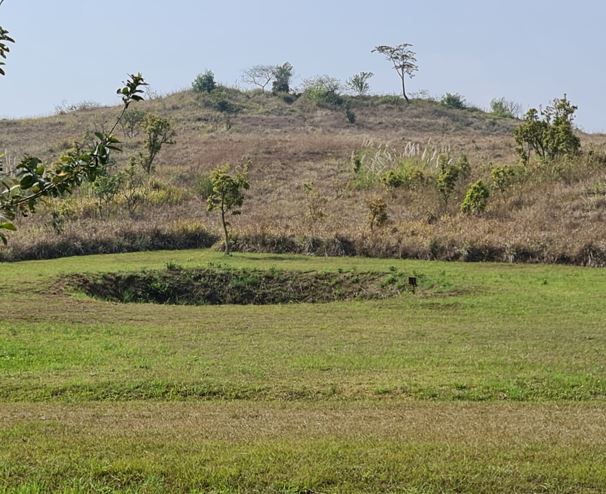
One of the bomb craters that pockmark the Plain of Jars.

Because Site 1 at the Plain of Jars offers sweeping views of the surrounding area it became a prime target of bombers during the Second Indochina War. Ancient jars were blown apart or completely obliterated. Even today, when wandering around the site, tourists run the risk of falling into bomb craters and trenches.

It’s a terrible irony that a place used to cremate and bury the deceased became a killing field two thousand years later. The descendants of those who made the jars have paid a heavy toll in dead and wounded for the Second Indochina War, a toll many of them still pay when they till their farms, or when children play in the fields, or when they simply walk along the hills, the ridges and valleys of Xieng Khouang.

#

The walkway around Phonsavan’s reservoir.

The people of the province – and its landscape – have been scarred by war, but while the past is something they cannot forget they’re not allowing it to shape their future.

AJ and I will definitely return to the PuKyo in the near future, not only to treat ourselves to Sakhone and David’s hospitality once more, but to visit the gentle rolling plains and hills with their megalithic stone jars, and to revisit the Mulberries Organic Silk Farm, and to spend more time with Xieng Khouang’s gentle, enterprising and resilient inhabitants.

(All photos: Simon Brown.)

For those interested in visiting Xieng Khouang, PuKyo B&B can be found here on Facebook.

16 February 2022: Laos

I’m writing this 50 days after moving to my new home in Vientiane, Laos. I’ve spent half that time sequestered from my fellow human beings: 14 days in quarantine on my arrival and a week later a further 11 days in self-isolation after contracting Covid 19 (and yes, from which I’m now recovered, thank you for asking).

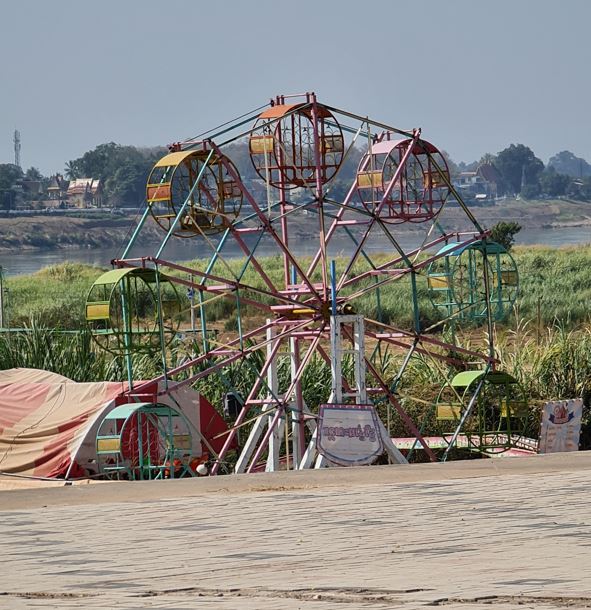
Covid restrictions have pretty well eliminated tourism in Laos. This is part of an abandoned circus by the Mekong. Photo: Simon Brown

In the remaining 25 days I’ve managed to get a handle on my local area – a village called Ban Donepamai in the district of Sisattanak – but other than a couple of walks through the city centre and along the Mekong River, I can’t really claim to have seen much of Vientiane let alone Laos.

For a city in southeast Asia it’s remarkably compact and small, with a population somewhere between 800,000 and a million, depending on which source you ask (compared with the eight to nine million people inhabiting Hanoi or Ho Chi Minh City or Bangkok, or even the two million plus living in Phnom Penh).

The Mekong from my quarantine hotel room. Photo: Simon Brown.

But then Laos itself seems remarkably compact, with an area about the same as the state of Victoria. It looks like an apostrophe tucked in between Vietnam, Thailand, Cambodia, Myanmar and China, and is southeast Asia’s only landlocked country. The Mekong runs through it the way the Nile runs through Egypt, providing not just water, silt and a transport route, but character as well. The Mekong also acts as a border between Laos and Thailand, and one of the most pleasant things to do in Vientiane is listen to the sound of bells and gongs drifting across the river from Buddhist wats.

Laos, a socialist country embracing communism, is controlled by the Lao People’s Revolutionary Party. The party’s hand lays very lightly on us foreigners. From our point of view, life in Vientiane runs just as it does in Bangkok or Kuala Lumpur, if at a much slower pace. People own their own small businesses and mainly serve their local community. At this level at least, entrepreneurship seems to be encouraged. Everybody works, and everybody works hard.

Laos has plenty of its own wats, most beautifully decorated. Photo: Simon Brown.

I’m sure censorship exists at some level, but so far I’ve not encountered it personally, and AJ has been told that she can teach any text relevant to her course. The only sign that we’re living in a one-party state is the slightly Orwellian speeches given every morning over loudspeakers. None of the loudspeakers seem to be near us, so what we hear is a metallically-distorted monologue that drifts across our district like a mumbled prayer from heaven. The tone is completely even, without any emotion at all, as if all that was being delivered were aircraft boarding announcements or department store messages.

As AJ told me soon after she arrived six months ago, Vientiane in 2022 is probably what Phuket was like in 1982. In my limited experience, the locals are formidably polite and quite reserved. They are always bustling and busy, either riding their scooters to or from work, or selling vegetables, take-away food or lottery tickets from behind makeshift stalls or shop-houses (with the living accommodation on the second floor or out back). As in Thailand, thick skeins of electric cable are suspended above every main street, and the faint waft of sewage drifts up from drains.

Electric cables so thick birds lay nests in them. Photo: Simon Brown.

Traffic is only busy at peak times, but even then everyone drives under 50 kph. If there are traffic rules, they’re interpreted differently by every driver, but drivers – and by necessity, pedestrians – are courteous and patient. There are some big SUVs and pickups around, but most cars are small Toyotas, Hyundais and Kias, and all of these are vastly outnumbered by the swarm of motor scooters that cough around the streets like asthmatic beetles. It’s a marvel to watch scooter-drivers spend half their time looking where they’re going and the other half checking their mobile phones while using some internal radar to avoid collisions.

AJ and I will be here for at least two years, possibly three or more, so plenty of time to get to know the city and the country, starting with the Plain of Jars in a couple of weeks and Luan Prabang in April. And, of course, once Covid restrictions ease (fingers crossed), Vientiane will make a good base for visits to Vietnam, Cambodia, Malaysia and Thailand. Rainforest, rivers, rapids, monsoons and the world’s best food bar none. I have to say, it’s wonderful being back in the tropics.

12 February 2022: Interregnum

Apologies to everyone for the long interval between blogs.

Over the last six months, AJ and I moved from Johannesburg, South Africa to Vientiane, Laos, travelling via Australia to catch up with family and friends. Because of the Covid 19 pandemic and its associated lockdowns, quarantines and interrupted international travel, this has been a long, long process.

As well, I’ve been planning on working on a major piece on human evolution for some time, something I’ve slowly – and somewhat painstakingly – put together over the last 10 months. The piece is based on a book a friend, palaeoanthropologist Colin Groves, and I were writing together. From the short few chapters we managed to write before his death in 2017, from memories of our many weekly conversations, and from subsequent conversations with his wife Phyll and colleague Debbie Argue, that piece is now all but done. Although nowhere near as comprehensive as the book would have been, it’s still far too long to be viewed in one go, and will appear on this blog over the next few weeks in six sections.

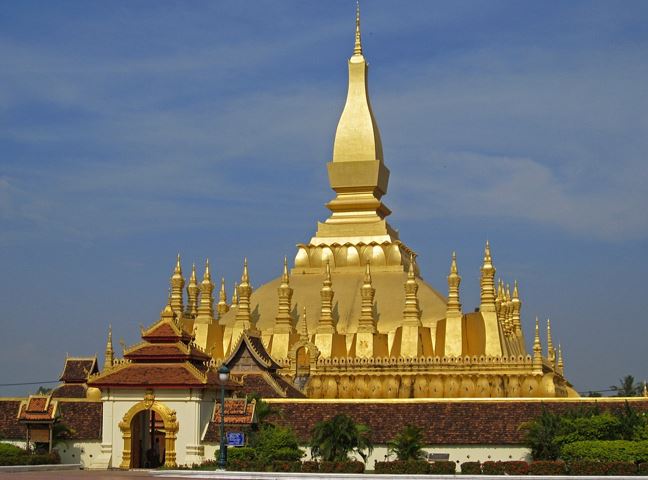
Pha That Luang, Vientiane. Photo: courtesy of Creative Commons (photographer unknown)

Almost as a counterpoint to thinking about human evolution – dealing with relatively deep time – I’ve also been thinking about more recent human history, something spurred on by the pandemic, as well as crises in the Ukraine and the West’s fumbling, erratic handling of the inevitable rise of China. In the process, I came across this short piece I wrote for a workshop two years ago, arguing that the Napoleonic War (or perhaps more accurately, wars) were an essential ingredient in the making of the modern world.

So here it is, the first in what I hope is a much more regular series of blogs.

Napoleon and the modern world

I know … boring Euro-centric, male-centric, and military-centric history. Not really history at all, at least not as its understood these days. But still, the effects of this long conflict did two things that helped establish the world we now live in. First, it saw the creation of the most dominant modern European states. Second, it led to the rabid drive to colonise and exploit Africa.

The so-called First World War – the Great War of 1914-18 – was no such thing. The first true world war was the Seven Years War and occurred in the 1750s . It was fought in Europe, the Mediterranean littoral, west Africa, North America, southern Asia and the Philippines. The Napoleonic War was more of the same – the Second World War, if you like – but with extra countries thrown in and fought on a much more massive scale: bigger armies, bigger battles, greater civilian casualties and dislocation, and huge fleets of giant wooden ships sailing across all seven seas.

Artist: Paul Delaroche. Photo courtesy of Creative Commons (photographer unknown)

One thing you have to say for the Europeans, when they throw a party they make sure everyone’s invited, whether they want to join in or not.

The Napoleonic War involved military, economic and social mobilisation on a scale never seen before. Just two examples: between 1805 and 1813, Napoleon conscripted over 2,000,000 soldiers, and by the end of the war British national debt reached 200% of GDP.

Of course, Napoleon was a megalomaniac, but he also introduced dramatic reforms or consolidated reforms brought in by the French Revolution. Just three examples: the legal system, the Civil Code, influenced similar codes throughout Europe; the metric system is now used almost universally; and state-sponsored voyages of scientific discovery.

The Napoleonic War entangled the US in its first international conflicts: first against the French themselves (their previous ally during the American Revolution), and then, in 1812, against the British (their previous opponent during the American Revolution).

Prussia’s success resisting the French during the war cemented its position as the leading German-speaking country – a process begun 50 years before under Frederick the Great – leading to the creation of the German state itself under the direction of the Prussian Bismarck.

It’s hard to measure to the last centimetre or the last centime or the last degree Celsius the effect all of this had on the rest of the world. But when we talk about nation states, modern economies, science, art, culture and yes, even history, we are dealing with many ideas that had their origin or first great flowering during the Napoleonic era. When the wars were finally done, the continent of Europe – exhausted and battered and Napoleon sent to his last exile on St Helena – experienced nearly a century of peace, something that had never happened before. Instead European states competed with each other overseas, most dramatically in the race to colonise Africa during the 1800s.

The raw materials of the modern world can be found in early European colonialism and 18th century industrialisation, but for all its benefits we enjoy and all its crosses we bear, it was forged during the Napoleonic War.