In 1977 two American microbiologists discovered a whole new branch of life: the archaea. Single cells without a nucleus, archaea are prokaryotes that for a long time were considered to be bacteria. The work of Carl Woese and George E. Fox, however, revealed that archaea are in some respects closer to eukaryotes (cells with a nucleus, which includes all multicellular life such as you and me) than bacteria.
As a result of their discovery, the traditional taxonomic tree, starting with kingdom and ending with species, was – so to speak – recapped. A new level was placed at the top of the tree – the domain – with three members: bacteria, archaea and eukaryotes.
‘So where do viruses fit in?’ I hear you ask.
Good question. Unfortunately, there isn’t a good answer. The issue is confusing because there is no clear understanding of their evolutionary development, or even if they share a common ancestor. Some may have developed from small, free-floating bits of DNA called plasmids, while others may have evolved from bacteria. It’s generally easier to hedge around the issue of whether or not viruses are actually alive rather than confronting it, and they are often simply called infectious agents or biological entities. The main sticking point is that viruses cannot replicate without infecting a host cell, and are therefore entirely dependent for their existence on ‘biological entities’ that are undoubtedly living. An example of how contentious this argument can be, however, is that the bacteria that causes the STD chlamydia can only exist in a host cell … therefore, should this bacteria be considered technically alive?
Now, to complicate matters even further, a preprint article published in bioRxiv earlier this year announced the discovery of ‘viroid-like colonists’ the authors call ‘Obelisks’, which sounds awfully like the proposed title for a 1950s sf monster movie set somewhere in Death Valley.
However, Obelisks are minute, not monstrous. In fact, they’re small enough to fit inside bacteria. The article’s first sentence describes them as a ‘previously unrecognised class of viroid-like elements that we first identified in human gut metatransciptomic data.’ Basically, they were found in samples of human poo. I think I’d prefer to research giant creatures rampaging through Death Valley, but to each their own.
In size they fit somewhere between viruses and viroids (infections strands of RNA), and are rod-shaped, hence their name. And despite only being discovered recently, they are a lot of them. As the authors report: ‘Large scale searches identified 29,959 Obelisks … with examples from all seven continents and in diverse ecological niches.’
At this point, researchers don’t know if Obelisks are truly alive or not, what they evolved from, or if they are harmful or beneficial to their host organisms. In other words, stay tuned.
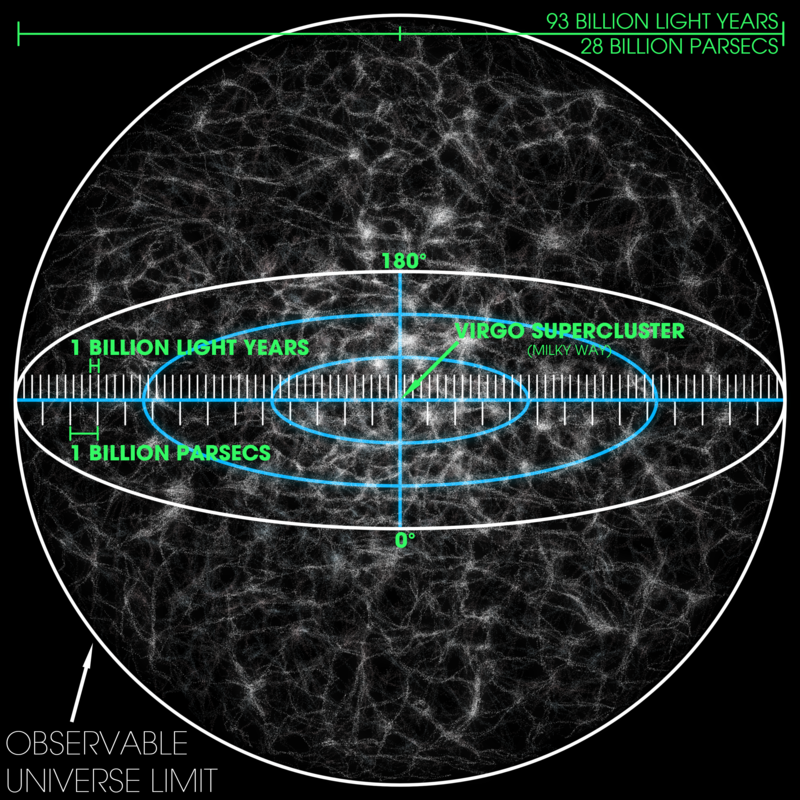
At the other end of the scale, a paper by two physicists from University College London suggest that dark energy and dark matter may not exist. To put this in perspective, under the currently most popular model of how the universe works – the lambda-CDM model (or, more simply, ΛCDM) – dark energy and dark matter make up nearly 95% of the universe. It’s like suggesting the theory of evolution through natural selection is fine except for the bit about natural selection … and maybe the bit about evolution.
Authors Jonathan Oppenheim and Andrea Russo ‘… consider a proposed alternative to quantum gravity, in which the spacetime metric is treated as classical, even while matter fields remain quantum.’ Making sense of this is way above my pay grade, but The Guardian’s science correspondent, Hannah Devlin, explains the theory this way: ‘(It) envisages the fabric of space-time as smooth and continuous (classical), but inherently wobbly. The rate at which time flows would randomly fluctuate … space would be haphazardly warped and time would diverge in different patches of the universe.’
If this sounds a bit like Doctor Who trying to explain time to Carey Mulligan’s character in the episode ‘Blink’, it may be because the universe is indeed ‘inherently wobbly’. It’s rather unsettling to think that the Weeping Angels might feel quite at home in Oppenheim and Russo’s universe.
Neither paper has been peer-reviewed at this point, but that hasn’t stopped them garnering media attention and commentary from other scientists. At the very least, ‘Obelisks’ and ‘wobbly spacetime’ have stirred the often lethargic currents of scientific orthodoxy; at best, they demonstrate that all scientific knowledge is provisional.
As FBI Special Agent Dana Scully says, ‘Mulder, the truth is out there.’
Which is why we keep on searching.
 Strange Borders