05 November 2014: Alim Khan

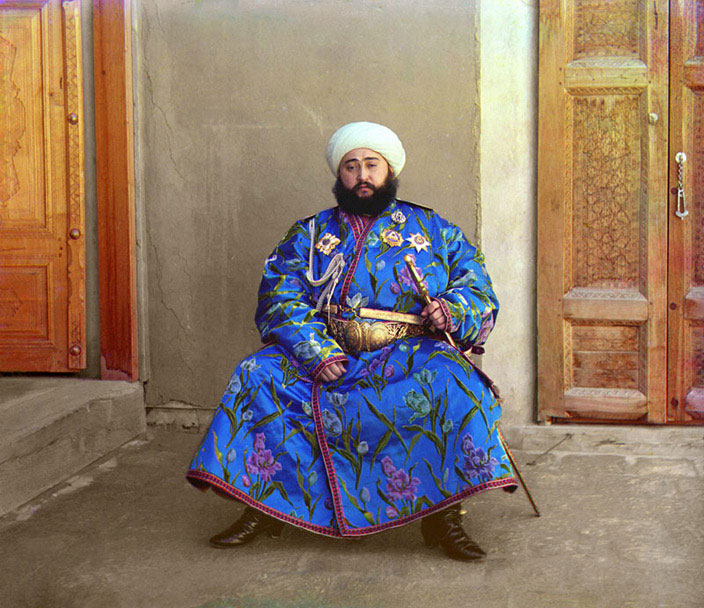
Emir of Bukhara c1910Meet Emir Said Mir Mohammed Alim Khan, the last emir of Bukhara. He looks rather splendid in his elaborate coat with its startling blue silk cloth with embroidered flowers and leaves. Then there’s the gold belt and, one suspects, quite functional sword. Above it all, however, rests the serene and confident visage of Alim Khan himself. He led an extraordinary life, and was the last direct descendant of Genghis Khan to rule a nation.

I say “was” because this extraordinarily clear and colourful portrait we have of him was taken in 1911, when Alim Khan was around 30 years old. He had just taken over the reins of power following the death of his father the year before.

The photograph was taken by Sergey Prokudin-Gorsky. With the support of Tsar Nicholas II, he spent six years travelling around the Russian Empire to document its people, its geography and its cultures.

The US Library of Congress has a wonderful collection of Prokudin-Gorsky’s photographs. The latest were taken just after the start of WWI, and only two years before the revolution which ultimately deposed Alim Khan from his throne.

Alim Khan died in Kabul, Afghanistan in 1944. His old emirate now lies within the borders of Uzbekistan, once part of the Soviet Union and now an independent republic.

04 November 2014: Sunlight reflecting off hydrocarbon sea on Titan

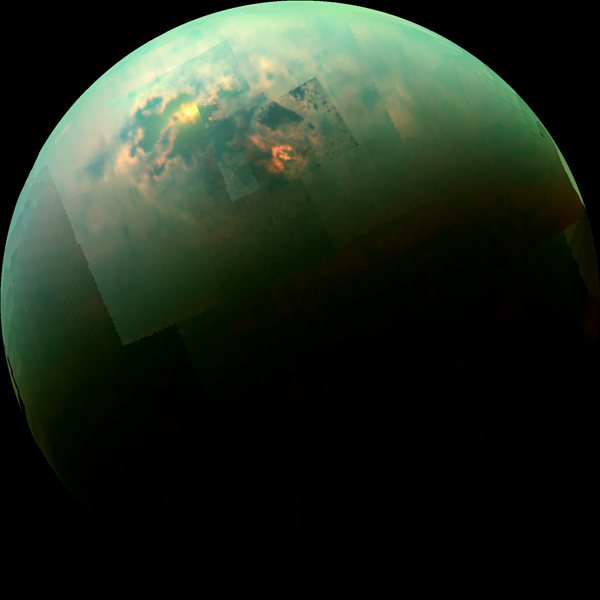
Go here to read up on the background to this spectacular image of Titan, Saturn’s largest moon and the second largest in the solar system. Titan is the only moon in the solar system with a significant atmosphere and surface liquid.

Photo courtesy of NASA/JPL-Caltech/University of Arizona/University of Idaho

Photo courtesy of NASA/JPL-Caltech/University of Arizona/University of Idaho

03 November 2014: Wowed by Wells

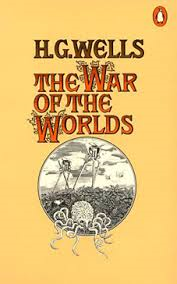
WotWIt was 1968 and I was eleven or twelve years old when I bought my first book with my own money. This is a pic of the cover of the very edition I bought. Not only do I still own it, it’s in pretty good nick for a book that’s 47 years old (this edition was published by Penguin in 1967). I love the cover; it reminds me of the pseudo-Edwardian craze that briefly inhabited British art at the end of the 60s, reflected in everything from men’s fashion to the design of the Wild Woodbine cigarette pack.

I knew of H.G. Wells, but had never read any of his work. I also knew about The War of the Worlds, mainly because I’d seen and loved the 1953 George Pal film on television the year before (tragically, in b&w). I was reading every science fiction book I could lay my hands on, and I was curious to see how it would read. I think it cost me all of 60 cents.

I was sucked in from the moment I read the first paragraph: “No one would have believed, in the last years of the nineteenth century, that human affairs were being watched keenly and closely by intelligences greater than man’s and yet as mortal as his own … intellects vast and cool and unsympathetic … ”

Thanks to Spielberg’s 2015 version, whenever I read those words now I hear Morgan Freeman’s baritone in my ears. To be fair, before Freeman it was Richard Burton’s voice I heard in my head, thanks to Jeff Wayne’s 1978 concept album. But whatever voice delivers the words, it is the writing – the phrasing, especially – that makes it ring.

The first section of the book, dealing with the invasion and its immediate aftermath, is still something I reread every year or so. And to this day I have not read or seen anything that imparts the same level of dread at the first appearance of a malevolent alien than the glistening, bear-sized mass that slithers from the Martian cylinder on Horsell Common. The only experience that comes close is the first glimpse of the creature in the Ridley Scott’s Alien, but that monster is clean-limbed and somehow thoroughly modern and mechanical, whereas Wells’ Martians are obscenely chthonic and organic.

The story’s influence on science fiction is probably immeasurable. Every alien invasion story owes something to Wells’ original.

For a long time I’d wanted to write something set in the same universe, or at least the same milieu. I’ve always admired Brian Aldiss’s homage “The Saliva Tree”, actually written to celebrate the centenary of Wells’ birth in 1866, and hankered to do something similar. In the end, my story “The Empire” unmistakably used The War of the Worlds as its spine, even if it mixes in rather a lot from the period, including music hall and Gilbert & Sullivan.

The film I would like to see almost more than any other, would be a version of The War of the Words that places the story in the period Wells himself placed it. Surely such a film would be the perfect vanguard for an effective steampunk invasion of the big screen?
03 November 2014: Article on HSC English Extension added

I’ve added an article I wrote in 2002-03 for the introduction of “Speculative Fiction” as an HSC English Extension subject for Year 12. Some things have changed a great deal since then, especially in the field of fantasy. I think the definitions and the sections on science fiction and Dune still hold up pretty well, however. It can be found here.

02 November 2014: But I discovered the meaning of life!

Who’d have thought that in a competition between scientific research papers on the wonders of sex, the bizarre mini-universe of quantum physics, the age and size of the cosmos, the last universal common ancestor, the wingspan of giant condors and the implications of relativity, the top three most cited papers would be about proteins?

The most recent issue of Nature, one of the world’s leading academic journals, has a fascinating article about the most popular papers in science.

The top three – and here you need to take a very deep breath – are “Protein measurement with the folin phenol reagent” (1951), “Cleavage of structural proteins during the assembly of head of the bacteriophage T4” (1970), and “A rapid and sensitive method for the quantitation of microgram quantities of protein utilizing the principles of protein-dye binding” (1976).

I didn’t even know “quantitation” was a word, let alone part of the title of a scientific articles that has over 150,000 citations.

For the full wherefore and whyfore, go read the article. In the end, as it generally does in science, it all makes sense.

31 October 2014: Homo floresiensis, aka the Hobbit, now 10 years old

It wasn’t as momentous as Copernicus displacing Earth from the centre of the universe, or Darwin displacing humans from the centre of creation, but ten years ago a team of Australian and Indonesian palaeontologsits announced a discovery that changed the way scientists view not just the history of humans, but the history of the entire human clade. If Darwin’s On the Origin of Species started an earthquake, then the discovery of a recently extinct tiny-limbed and tiny-brained human on the Indonesian island of Flores started a serious tremor.

The waves from that tremor are still rippling through palaeontology. Some scientists argue that the new human, dubbed Homo floresiensis but more often referred to as the Hobbit in popular media, is nothing more than a diseased remnant of an isolated population of modern humans. It does seem, however, that proponents of this hypothesis are increasingly desperate to prove their case. The most recent argument is that the remains display classical symptoms of Downs syndrome. I’m still waiting for them to wheel out childhood smoking as the cause for the Hobbit’s miniature status.

It seems to me that the weight of evidence is overwhelmingly on the side of Homo floresiensis being a new member of the human family. It has no chin, its leg bones are unusually thick, and its wrist bones more closely resemble those of an African ape or group of ancient humans called Australopithecines.

Another piece of evidence that H. floresiensis was not a dwarf or diseased version of H. sapiens is the stone implements found with the remains. These tools are the size you’d expect them to be if made by and for humans around a metre tall. More importantly, they and the bones were found in strata laid down as long ago as 95,000 years ago. Modern humans did not arrive in Indonesia until about 45,000 years ago.

The great mystery surrounding H. floresiensis is where exactly it fits in the human clade. Most evidence suggests it is a very primitive member of the genus Homo, but perhaps, just perhaps, it belongs in the group of Australopithecines with A. afarensis and A. africanus.

The one outstanding fact about this tiny cousin of ours is that it may have survived at least until 18,000 years ago, and possibly even as recently as 12,000 years ago. The Neanderthals, our closest relative among all the species of humans that have walked the Earth, died out not later than 35,000 years ago.

Homo floresiensis was a true survivor.

[For more information about the discovery of the Hobbit, go here. For more information about the history of the debate on whether or not the Hobbit is a new species, go here.]

29 October 2014: Voting and democracy

Politicians screwing voters is – and always has been – par for the course in democracies. A particularly obnoxious and racist attempt at blindsiding a huge chunk of citizens took place in the US this month.

As reported in The Guardian and The New York Times, a recent decision by the Supreme Court of the United States allows Texas to impose strict ID conditions on voters. The move may effectively disenfranchise an estimated 600,000 registered voters in the upcoming 4 November midterm elections. Overwhelmingly those disenfranchised will be poor African Americans and Latinos. It is seen by many as an attempt by the Republicans to reduce the growing electoral power of minorities in Texas, minorities who traditionally vote Democrat.

Republicans argue the new measures were introduced to combat voter fraud. However, as the story in The Guardian points out, only two cases of fraud out of 20 million votes have been brought to conviction in the past 10 years.

I would like to think that this kind of political bastardry could never happen in Australia, not from any hope that Australian politicians are more virtuous than their American counterparts, but because voting in Australia is compulsory. I suspect voter fraud is potentially easier to hide when only 63% of the population turns out to vote (as it did when Obama was elected president in 2008), as opposed to the 93% that turned out in the 2013 Australian federal election.

More importantly, although compulsory voting doesn’t stop political parties from damaging their opponents through other tried and trusted means, when voting is mandated by law it’s harder for governments to put up hurdles.

The main point I want to make about compulsory voting is that it is the best expression of the idea that, in a democracy, voting is a responsibility and not a right. This was recognised from the very start of democracy, in ancient Athens, when citizens who could vote at assemblies were believed to have the duty to do so.

At its heart, democracy guarantees no rights at all. The only thing democracy guarantees is the equal distribution of political responsibility among enfranchised citizens: one person, one vote. Democracy does not tell us who can or cannot be a citizen, or who can or cannot be enfranchised. Democracy does not guarantee freedom of speech or freedom of assembly. Democracy does not guarantee equality before the law.

Voters in a democracy can certainly bestow any or all of those rights on citizens (and, indeed, non-citizens). Just as certainly voters in a democracy can diminish, curtail or repeal those rights.

High voting turnout for elections makes democracy more representative and therefore more stable. Whether it is the law or political engagement that gets the voter to the ballot box, a strong democracy is more likely to serve all the citizens rather than a select few.