
07 December 2014: Review of “Genesis”

Abraham about to sacrifice his son Isaac, by Anders Lauritzen Smith in Stavanger Cathedral, Norway. Photo: Arnstein Ronning.
Dear Jehovah
Thank you for submitting a sample chapter and a synopsis of your first book: The Bible.
While we at Sesostris and Sons Publishers think the story has potential, on this occasion we’ll pass on it.
Our readers generally felt that the sample chapter – “Genesis” or “Bereshit” – lacked narrative balance and would almost certainly benefit from a second draft.
The major points to look out for if you should consider rewriting include the following.
First, cut out the genealogies. They contributed nothing substantial to the story. We understand you are trying to establish a link between Adam and his offspring with the various peoples and kingdoms of the Bronze Age Levant; regrettably, your evidence for this is unconvincing. Either beef up these sections or delete them entirely.
Second, introduce more female protagonists. Your strongest female characters – Sarah and Rebekah – have authority only through their marriages with their husbands. In this day and age of strong female role models such as Hatshepsut here in Egypt and female deities such as Astarte, the readers felt you could have introduced female characters able to stand on their own two feet. (As an aside, and referring back to the chapter’s genealogies, did Adam and his descendants have any female children? And what is Sarah’s problem with Hagar? It is never clearly explained.)
Third, there is some confusion about the issue of ethics in the chapter, and how it confounds the willing suspension of disbelief which is so vital in a good fantasy. In many places your role as background deity seems to undersell your authority as an agent of morality. Your instruction to Abraham to murder his own son Isaac is a case in point: it is difficult to engage the reader’s sympathy with the preeminent hero figure of “Genesis” if he comes across as an insufferably sycophantic child murderer.
Fourth, your attempt at world building is slapdash at best: are you aware you have two versions of Creation in the chapter’s first section, and two versions of Noah’s flood? Some careful editing on your part would have avoided much confusion.
On the positive side, our readers thoroughly enjoyed the story of Joseph. The antagonistic relationship he shares first with his siblings and later, in Egypt, with Potiphar’s wife, add real local colour and passion to a chapter that is too often bereft of both. When Joseph later demonstrates mercy and forgiveness towards his siblings, the story almost reaches a kind of magnificent grandeur. (Indeed, one of our readers thought this story in particular would make a fine subject for a musical.)
As well, our readers were impressed with some elements that could be developed further. For example, the Nephilim; giants are always popular with the book-buying public and would make a great selling point, especially since you hint they have sexual relations with humans. More titillation would go a long way to making “Genesis” more accessible.
Finally, “Genesis” reads as if it had been ghost-written by some barely literate shepherd in Hebron. Might I suggest consulting other contemporary works such as The Epic of Gilgamesh and The Vedas to get some idea of the standard expected these days by the reading public?
If you do rewrite “Genesis”, we at Sesostris and Sons Publishers would be happy to take a second look at it.
Best regards
Senusret, son of Sesostris of Memphis
05 December 2014: Graffiti – a primate thing

Photo: Wim Lustenhouwer, VU University Amsterdam
What had up to now been the most ancient example of graffiti, at a respectable 100,000 years old, has just been royally trumped.
Published in science journal Nature on 3 December was the announcement by a group of scientists led by José Joordens from Leiden University in the Netherlands that a sea shell had been discovered with etchings that go back around 500,000 years.
Not only does this push the graffiti timeline back by a factor of five, it also means the rough etching wasn’t made by a member of our species.
The artist in this case almost certainly belonged to Homo erectus, which says a great deal about how deeply ingrained is the hominin need to create art.
Go here to get the story from Dr Joordens herself, who point out the contribution made by Dr Stephen Munro, a biological anthropologist from the ANU.
02 December 2014: Go west, young man!
Embed from Getty Images
This is about latitude and longitude and the different way humans think about geography.
In making Wanderers, Erik Wernquist used the voice of Carl Sagan from an audio recording of his book Pale Blue Dot. At one point in the voice-over Sagan says Herman Melville “spoke for wanderers in all epochs and meridians”.
The phrase stuck in my head as an example of wonderful writing. I could live to be a hundred and never come up with words that so aptly and concisely express a single thought. And then I realised that even if I was as smart and knowledgeable as Sagan, and could turn a phrase as adroitly, I would still never use the world “meridian”.
Australians – I suspect – tend to think of their country from north to south. We all know there is a Western Australia and an east coast, but when most of us think of the Australian continent what we conceptualise is a tropical north, an arid centre and a temperate south. Australia lays south of the equator, and most of our cultural cousins lay north of it. Europeans did not occupy one coast and work their way across to the other side. They first occupied the margins of the continent, circling the landmass like a halo, and then sent expeditions into the centre.
Compare this with the way Europeans and North Americans seem to think of their respective geographies. There’s the Russian Bear in the east, the Middle East, the Far East, the Western Hemisphere. There’s Western Europe and Eastern Europe. There’s Western Civilisation. There’s the orient and the occident. To the best of my knowledge, no Englishman referred to France as the Near South and no Italian thought of Scotland as the Far North. The greatest navigational difficulty for early trans-Atlantic explorers was determining meridians of longitude, not parallels of latitude.
In the US, New York editor Horace Greeley exhorted young Americans to “Go west!”. Of course, if you live in America there is the South and the Bible Belt (with its hint of latitude), but American mythology expresses the urge to go west, to explore and settle new lands, to link the US not from Grand Forks to Corpus Christi but from New York to Los Angeles. Lewis and Clark didn’t make their way along the continental divide, they crossed it, east to west, and the great example of 19th century American industry and technology was the transcontinental railroad finished in 1869.
I’m not sure this says anything about our respective psychologies, but I think it says something about our history and geography.
01 December 2014: So cool …

Jupiter seen from the icy surface of Europa in “Wanderers”.
Go watch Wanderers, a short SF film by Swedish artist Erik Wernquist It will take up less than four minutes of your time.
30 November 2014: Call for moral “bioenhancement” a moral mash
Embed from Getty Images
A call to use technology to improve human morality falls short on morality, not to mention logic.
“Are we fit for the future? Making the case for moral bioenhancement” by Julian Savulescu and Ingmar Persson makes several outsized claims and suggests an equally outsized solution for them.
Their first argument is that “evolutionary pressures have not developed for us a psychology that enables us to cope with the moral problems our new power creates”.
This begs the question of what examples they have to support the argument. It is true we have the technological capacity to willfully destroy ourselves, and yet last time I looked civilisation still flourished. World War II created a dramatic interruption to civilisation and led to the creation of what is to date perhaps our most terrible invention – nuclear weapons – but it was followed not by Armageddon but by the United Nations, the elimination of small pox, the first landings on the moon, novels by Chinua Achebe, Harper Lee and Zadie Smith, films by Alfred Hitchcock, Gillian Armstrong and Stanley Kubrick, music by Philip Glass, Patti Smith and the Beatles, works of art by Ai Weiwei, Henry Moore and Zaha Hadid, revolutionary texts by Rachel Carson, Germaine Greer and Peter Singer. All this was brought into being by human ingenuity and applied and appreciated with the always evolving tool of human psychology.
I think the only way the authors can pretend that our psychological capacity lags behind our intellectual capacity (in all its forms), is if they ignore the ever-widening sphere of human knowledge and experience and, thanks to the Internet, its increasing relevance in our day-to-day lives.
Savulescu and Persson also argue that a “basic fact about the human condition it that it is easier for us to harm each other than to benefit each other”.
Truly? Do Savulescu and Persson, for example, practice hurting people instead of helping them? I don’t. I know almost no one who finds it easier to harm another person rather than benefitting them. This doesn’t just apply to my own family, my own community, my own town. Most people I know have at some point in their life donated time or money, experience or knowledge, to the benefit of people living in another continent, and never willingly committed any act to harm them.
I’m not denying our species is capable of gross inhumanity. The bouts of war and terrorism that flood our television screens on the evening news are testament to our capacity for violence. But those same television reports almost never cover the activities of the Red Cross or Médecins Sans Frontières, and almost never cover the work of the United Nations and its agencies in aiding developing countries all over the world.
It almost seems the authors willingly ignore the evidence indicating humans individually and collectively find it easier – physically and psychologically – to benefit and not harm one another.
The article provides one “case study” to illustrate their point that our “moral psychology” lags behind our intellectual capacity: the lack of international action over climate change. And yet this issue is the very one that has engaged and energized not only individuals and communities, but entire nations (not to mention endless news cycles). While real action has been agonizingly slow, one of the main reasons for this is the nature of the very institutions – such as the United Nations – employed to tackle the problem, institutions that were created to enable peaceful and cooperative behaviour between nation-states.
The great irony of this article, however, is that Savulescu and Persson, then claim that “our knowledge of human biology … is beginning to enable us … to affect the biological or physiological bases of human motivation”, and that this should be be done through drugs, genetic selection or engineering, or by using external devices that affect the brain or the learning process. What better example could there be of we humans using our technological capacity to harm ourselves despite our moral psychology screaming at us to cease and desist?
Who would administer these procedures? Who would receive them? Who would apologise to future generations for the loss of the full capacity of their genetic inheritance in the name of some nebulous greater good? Who would explain to future generations that as with the great 20th century evils of eugenics and forced sterilisation everything was done with the very best of intentions, coloured by our limited knowledge of human psychology, not to mention our limited knowledge of human evolution and biology?
The underlying concern of Julian Savulescu and Ingmar Perrson that our morality needs to keep pace with our technology is an example of how our morality is indeed keeping pace with our technology. Perhaps they should pause in their crusade and take an opportunity to lie down, have a nice cup of tea, and reflect instead on the possibilities of our better natures.
19 November 2014: AI not a threat
Embed from Getty Images
It’s remotely possible that an AI already exists, burbling away quite happily and innocently somewhere on the Internet, ignorant of the miracle of its own existence and no more self-aware than a box of tissues.
The possibility that it’s plotting the destruction of humanity, let alone all life on Earth, seems remarkably unlikely. It may not even realise in any logical sense that there is such a thing as biological life.
And if its intelligence was to develop self-awareness (a big ask) and subsequently an awareness that other life exists (another big ask), so what? Why would it divert resources away from sorting through key words for the NSA (or whatever task it was created to fulfil) to devise some method of eliminating humanity? What broken thread of logic would set it on such an absurd course?
But what if an AI accidentally sets off Armageddon?
In an article for the New York Times titled “Artificial Intelligence as a Threat”[i], technology writer Nick Bilton raises the possibility of a “rogue computer” derailing the stock market, or a robot programmed to fight cancer concluding “that the best way to obliterate cancer is to exterminate humans who are genetically prone to the disease.”
Well, hell, why not go the whole hog and create an AI that can both derail the stock market and exterminate humanity?
In both of these scenarios, surely AI is at best an option? I can imagine a plain old stupid robot making both of these mistakes because of crappy programming or intentional sabotage. Neither case is a genuine argument for we old-fashioned biological intelligences to be afraid of AI. (They may, however, be arguments for us to be afraid of important decision-making being taken from human hands and put into the silicon hands of machines that don’t give a damn, whether or not their processors amount to real intelligence or just a hill of beans.)
Bilton then raised the possibility of self-replicating nanobots being programmed by someone of “malicious intent” to extinguish humanity. But again, the nanobots don’t have to possess AI for this nightmare to become a reality.
Bilton concludes with two possible problems with AIs put forward by futurists like Elon Musk. First, that AIs created to make decisions like humans will not have a sense of morality, and second, that intelligent machines will one day go on to build even more intelligent machines that ultimately will lord it over the planet.
While it is true that AIs are unlikely to have a sense of morality, they are no more likely to experience murderous paranoia, or indulge in sociopathic tendencies. A human without any morality may want to kill other humans, but how does that translate to an AI without morality wanting to kill humans, or for that matter kill other AIs?
As for AIs creating super-AIs that end up ruling the earth, why would they want to? I love playing Civilization V on my computer, and using my tanks and political clout to take over the whole game map, but if I had a brain the size of the Empire State Building there’s about a zillion other things I could do that would keep me entertained and fulfilled, and none of them involve bending creatures of lesser intelligence to my will. There’s a whole universe out there to explore, and telling the Simon Browns of this world what to do or how to do it simply wouldn’t float my chip.
[i] And three days later picked up by the Sydney Morning Herald for its weekend edition of 8-9 November 2014, which is where I came across it.
14 November 2014: Elections and gerrymandering

Photo courtesy the Australian Electoral Commission
When Massachusetts governor Elbridge Gerry signed off on a bill that reorganised his state’s voting districts to suit his own political party, the Boston Gazette coined the term “gerrymander” because one of the new districts looked like a salamander. This happened way back in 1812, but gerrymandering is still a feature of democracies worldwide.
In the recent midterm elections held in the US, for example, the Republicans won the state House in Michigan 63 seats to 47, despite winning less than 50% of the popular vote. If the districts had been fairly assigned, the Democrats would now be controlling the state House 56-54. [For these and other figures, go here. Thanks to Dispatches from the culture wars for the heads-up.]
This isn’t to heap scorn on the American political system – Australia, too, has had its fair share of gerrymandering and malapportionment – but to heap praise on an Australian institution that gets almost no attention unless it does something wrong, an incredibly rare event.
The Australian Electoral Commission was created in 1902. One of its chief responsibilities is the redistribution of federal electoral boundaries so that every state and territory electorate has a similar number of potential voters. There is one rider to this redistribution: no state can have less than 5 electorates, and no territory can have less than 2 electorate, a result of promises made to the states at federation (a result that favours Tasmania with one extra seat – giving them a total of 5 electorates).
Since the beginning of this century, all Australian state governments also follow the principle of “one vote, one value” in assessing the boundaries of state electorates.
I worked in the AEC for a short time in the middle 80s, and know firsthand of the organisation’s dedication and professionalism. If only voters in democracies the world over had a similar impartial institution to manage elections and organise electoral redistributions.
10 November 2014: A short review of Interstellar
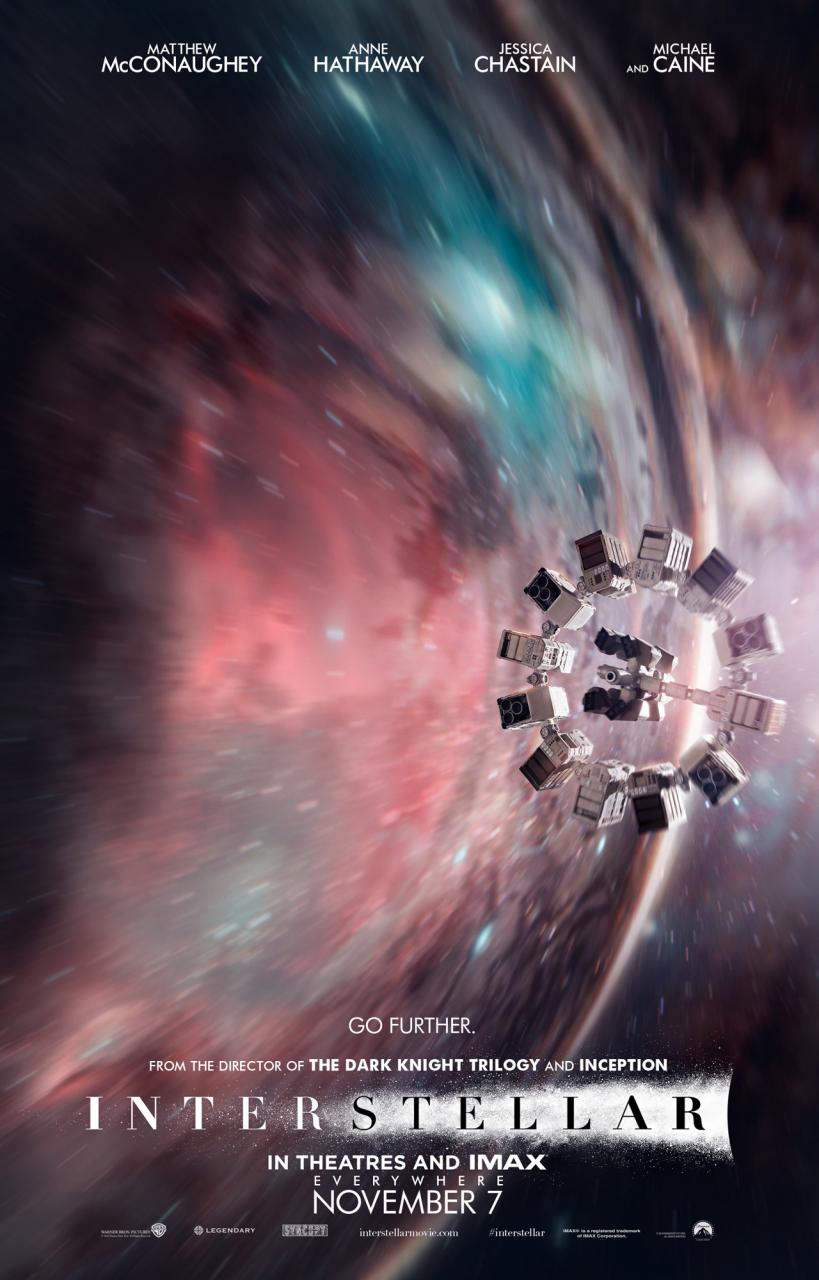
Copyright © 2014 by Warner Bros. Pictures and Paramount Pictures. All Rights Reserved.
Without wanting to push the metaphor too hard, watching Christopher Nolan’s Interstellar is a bit like going on a first date. There are moments when you wonder if you haven’t made a terrible mistake in going to see the film, and other moments when you are seduced by startling visual beauty or revelatory lines of dialogue. And like many a first date, the whole is a much more fulfilling and enjoyable experience than its parts.
In truth, I wasn’t expecting a lot. I was disappointed with the Dark Knight trilogy and was bored by Inception. But Interstellar impressed me not just as a good film, but possibly a great science fiction film. It touches on two aspects of science fiction – a sense of wonder and a personal human connection with the universe – that contribute to my love of the genre.
Some of the finest scenes in the film are those dealing with the implications of relativity on the passing of time; they carry a heavy emotional weight (and here I intentionally avoid the word ‘gravity’) that while entirely manipulative never succumb to melodrama.
All credit to producer Lynda Obst and physicist Kip Thorne for the original scenario, and Jonathan and Christopher Nolan for the script. All credit to McConaughey, Hathaway and Caine for their performances, and a special credit for the acting of Mackenzie Foy, Jessica Chastain and Ellen Burstyn for portraying the three ages of Murphy Cooper. And finally, all credit to Christopher Nolan for delivering a huge movie with huge ideas without ever losing a very human perspective.
06 November 2014: Dragonflies

Sp. unknown (pos. Neurothemis fulvia?).
Photo: Simon Brown
Small blog on dragonflies. Just because.
And because they are incredibly beautiful. And because they are incredibly ancient, among the first flying insects. Extinct proto-dragonflies, sometimes called griffenflies, could have up to 70cm wingspans. They lived from the late Carboniferous to the late Permian.
Dragonflies are also the fastest insects, and can fly backwards, which is pretty cool.
Also I’ve got this photo I took in Phuket. Not quite a griffenfly, but pretty nonetheless.
 Strange Borders